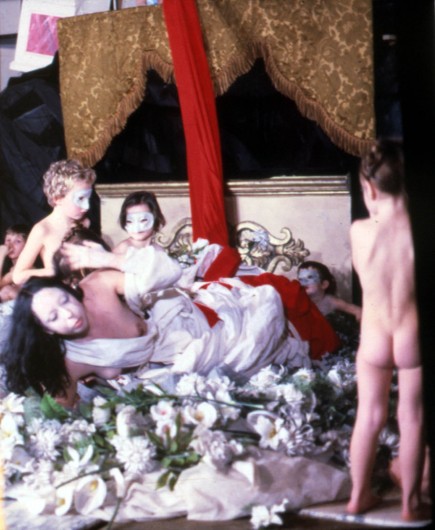
Each year, at the Michel Laclotte Auditorium, a leading figure in contemporary art is invited to give three lectures, sharing their perspective on the museum. As a home for artists, the Louvre invites contemporary creators to explore the many connections their own work has with the museum.
ORLAN was the guest artist at the Louvre Museum in 2026.
Third Lecture / WEDNESDAY, SEPTEMBER 30, 2026:
ART: THE CORNERSTONE OF RESISTANCE IN TIMES OF WAR AND OPPRESSION
The third lesson, “ CREATING TO SPEAK OUT: ART AND ITS RESPONSIBILITY IN TIMES OF WAR AND OPPRESSION, ” examines the ethical and political power of art by observing the depiction of suffering, the elderly, conflicts, wars, torture, and disabled bodies. I highlight the degradation of bodies, as have other socially engaged artists such as Goya, Otto Dix, Picasso in *Guernica*, or Emeric Lhuisset…
Creation is never neutral: art must bear witness, expose injustices, and open windows onto the world, confronting the viewer with the truth of history and the moral choices involved in representation.
no images were found
Second Lecture / FRIDAY, JUNE 12, 2026:
NAKED WITHOUT HAIR.THE REPRESENTATION OF THE BODY IN ART: BETWEEN VISIBILITY AND TABOOS
The second lesson, “ NAKED WITHOUT HAIR. THE REPRESENTATION OF THE BODY IN ART: BETWEEN VISIBILITY AND TABOOS,” explores the body in the face of the tyranny of censorship, driven by the leitmotif of social, political, and religious control.
From the idealized ancient nude to the blurring out of women’s breasts and bodies on social media.
I highlight the tension between nature and culture, freedom and constraint, by reinventing and reshaping the female body in my performances and installations.
By also examining the place of women in art history and society, by cataloging examples of prohibitions throughout history, and by discussing the body tortured and ravaged by censorship.
no images were found
First Lecture / FRIDAY, MAY 22, 2026:
THE MUSEUM AND ART HISTORY: THE STEM CELLS OF OUR NEW IMAGES
The first lesson, “ THE MUSEUM AND ART HISTORY: THE STAM CELLS OF OUR NEW IMAGES ”examines art history and museums as sources of information and inspiration. It is a constructed history of art, for there is no single history of art, but rather histories of art constructed through omissions, preconceptions, and censorship.
I show how images—whether traditional or generated by artificial intelligence—never arise out of a vacuum, do not come from nothing, and are not invented ex nihilo, but are nourished by references, connections, and reinterpretations. I illustrate this idea by engaging in a dialogue with works such as The Winged Victory of Samothrace and Caravaggio’s, Botticelli’s *The Birth of Venus*, Correggio, Bernini, Ingres, and Goya… Transforming this artistic heritage into contemporary and critical works.
There are no new images.
All the images are old and built upon the previous ones.
AI-generated images are no exception, but they are produced using different tools.
“Slow” by the artist, a concert-performance with Les Tétines Noires during the opening of the solo show ORLAN: Artistic Intelligences at the Muffathalle in Munich, curated by Dr. Jens Hauser, 2026
no images were found
ORLAN RELEASE PARTY FOR THE ARTIST’S “SLOW,” AFTER-PARTY, SILENCIO CLUB, 2023
To celebrate the release of her debut album, “Le Slow de l’Artiste,” on May 26, 2023, ORLAN is hosting a release party and performance on May 31, 2023. She is organizing a two-part event: The Grand Prix du Slow de l’Artiste during an album listening session in the historic billiards room at the Olympia, followed by an after-party featuring an awards ceremony, live performances, and a DJ set at the Silencio Club.
These images testify to the After Party at Silencio, where ORLAN performed “Je Suis Slowsexuel.le” with Sir Alice and “Les corps de métiers m’excitent” with Tentative, who also provided a DJ set throughout the evening. Octave de Bascher photographed the event and its exceptional guests. Her costume was designed by Beñat Moreno, and featured a lycra dress and chiffon cape. He created a textile print using the slogans on the signs, all in black and white. With this costume, ORLAN becomes a manifesto, visually embodying her concept. The Grand Jury, comprising President Michèle Lamy, Diane Pernet, Christophe Mecca, Sophie Rosemont, Sophie Duplaix, Elisabeth Couturier, Laurent Goumarre, Florence Tredez, Leïla Voight, François Renard, Raphaël Fontang and Léonard Lasry, awarded first prize to Mimosa, who received the original Slow de l’Artiste cape, made by Beñat Moreno, as well as an edition of L’originie de la guerre, second prize to Sir Alice, who received an edition of Zoom Baroque, Plis et Déplis, and third prize to Tentative, who received an edition of La pétition contre la mort. Tentative, doubly rewarded, won the Audience Prize, and received an edition of ORLAN and l’ORLANoïde: Masques sans corps sur texte généré par l’ORLANoïde.
Following her performance le baiser de l’artiste (the artist’s kiss) at the FIAC in 1977, ORLAN presents le slow de l’artiste (the artist’s slow), her very first “all slow” album! She wants to offer what we’ve missed most since March 17, 2020: human warmth, hugs, body-to-body… she wants to bring bodies closer together after physical distancing!
She realized that many of her assistants had never slow-danced before, and decided that she couldn’t go on like this – she had to do something for young people! With this project, she hopes to help people discover and revive this dance as a therapeutic treatment in this still difficult period of reconstruction.
ORLAN wrote the lyrics for each slow, which she then proposed to musicians to create the melody and sing her texts. She then inserted her voice into the music, in collaboration with the guest.
This album brings together twenty extraordinary slow songs created by Orlan in perfect harmony with some fantastic artists: Sir Alice, Jean-Claude Dreyfus, Terrenoire, Les Tetines Noires, Les Chicks On Speed, Mimosa, Yael Naim, Tentative, Régis Campo, Myope, Blue Carmen, Les Sans Pattes, La Femme, Romain Brau, Charlie Morrow, Demi Mondaine, Charlemagne Palestine, Kat May, and Iury Lech.
The vinyl is on sale at FNAC and on all platforms. Several clips have been produced to visually illustrate ORLAN’s message: she made “Je suis slowsexuel.le” with Sir Alice and “Les corps de métiers m’excitent” with Tentative. A book will be published with texts written by the artist. ORLAN has performed on several occasions with musicians including Demi Mondaine on Culture Box.
Photo: Octave de Bascher ORLAN’S Designer: Beñat Moreno
no images were found
ORLAN RELEASE PARTY FOR THE ARTIST’S ALBUM *SLOW*, JURY GRAND PRIX, SALLE DU BILLARD, OLYMPIA / AFTER-PARTY, SILENCIO CLUB, 2023
To mark the launch of her first musical album “Le Slow de l’Artiste” on May 26, 2023, ORLAN will stage a release party/performance on May 31, 2023. She orchestrates a double event: The Grand Prix du Slow de l’Artiste at an album listening session in Olympia’s historic billiard room, and an After-Party, during the awards ceremony, with live performances and a DJ-set at the Silencio Club.
ORLAN collaborates with Say Who to photograph the Grand Jury Prize. Laurent de Cernet, director of Olympia, opened the doors of his historic billiard room to ORLAN for this major event. Ruinart teamed up with ORLAN to make the evening even more sparkling, and the artist herself offered her iconic recipe for Lait de Vierge, guaranteed impure, with no colorants or preservatives. She proposed a listening session commented and performed by Beñat Moreno, so that an exceptional jury could vote for the three best slows on the album. The jury included President Michèle Lamy, Diane Pernet, Christophe Mecca, Sophie Rosemont, Sophie Duplaix, Elisabeth Couturier, Laurent Goumarre, Florence Tredez, Leïla Voight, François Renard, Raphaël Fontang and Léonard Lasry. A few VIPs joined us for the event, which was followed by an after-party at the Silencio Club. Her costume was designed by Beñat Moreno, and featured a lycra dress and chiffon cape. He created a textile print using the slogans on the signs, all in black and white. With this costume, ORLAN becomes a manifesto, visually embodying her concept.
Following her performance le baiser de l’artiste (the artist’s kiss) at the FIAC in 1977, ORLAN presents le slow de l’artiste (the artist’s slow), her very first “all slow” album! She wants to offer what we’ve missed most since March 17, 2020: human warmth, hugs, body-to-body… she wants to bring bodies closer together after physical distancing!
She realized that many of her assistants had never slow-danced before, and decided that she couldn’t go on like this – she had to do something for young people! With this project, she hopes to help people discover and revive this dance as a therapeutic treatment in this still difficult period of reconstruction.
ORLAN wrote the lyrics for each slow, which she then proposed to musicians to create the melody and sing her texts. She then inserted her voice into the music, in collaboration with the guest.
This album brings together twenty extraordinary slow songs created by Orlan in perfect harmony with some fantastic artists: Sir Alice, Jean-Claude Dreyfus, Terrenoire, Les Tetines Noires, Les Chicks On Speed, Mimosa, Yael Naim, Tentative, Régis Campo, Myope, Blue Carmen, Les Sans Pattes, La Femme, Romain Brau, Charlie Morrow, Demi Mondaine, Charlemagne Palestine, Kat May, and Iury Lech.
The vinyl is on sale at FNAC and on all platforms. Several clips have been produced to visually illustrate ORLAN’s message: she made “Je suis slowsexuel.le” with Sir Alice and “Les corps de métiers m’excitent” with Tentative. A book will be published with texts written by the artist. ORLAN has performed on several occasions with musicians including Demi Mondaine on Culture Box.
Photo: Michael Huard/Say Who ORLAN’S Designer: Beñat Moreno
no images were found
Showcase of Slow de l’artiste at CENTQUATRE Paris, with ORLAN, Sir Alice, Tentative, Demi Mondaine, Blue Carmen and Kat May, 2023
A few months before the release of her first musical album “Le Slow de L’Artiste”, ORLAN created an immersive art installation at the CENTQUATRE Paris, designed to tease out her future musical project. The album is previewed in this installation, on a loop, all day long. A video projection illustrates each of the songs, accompanied by a karaoke machine allowing the audience to sing along.
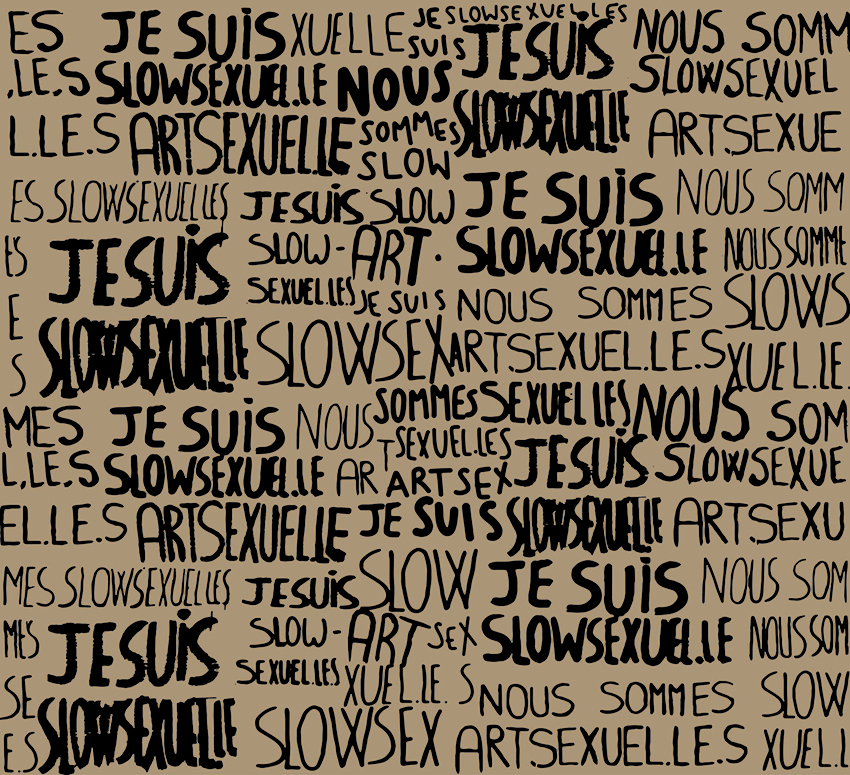
Of course, spectators were invited to dance, to get closer, to rediscover themselves…. ORLAN lines the exhibition room from floor to ceiling with cardboard signs bearing the project slogans “JE SUIS SLOWSEXUEL.LE”, “NOUS SOMMES SLOWSEXUEL.LE.S”, “JE SUIS ARTSEXUEL.LE”, “NOUS SOMMES ARTSEXUEL.LE.S”. These signs were used by ORLAN during her first demonstration “Je Suis Slowsexuel.le”, which appears at the end of her eponymous title “Je Suis Slowsexuel.le”. They have become a ubiquitous iconographic feature of the project. Facet balls and light projections create a sensual, intimate space. ORLAN created two augmented reality avatars in her image, in reference to the album cover. One in a blue wig, the other in a two-tone wig, both in costume with her manifesto dress. Her costume was designed by Beñat Moreno, and featured a lycra dress and chiffon cape. He created a textile print using the slogans on the signs, all in black and white. With this costume, ORLAN becomes a manifesto, visually embodying her concept. To mark the closing of her exhibition, ORLAN stages the very first showcase of the album, performing “Je Suis Slowsexuel.le” with Sir Alice, “Contre la Mort” with Demi Mondaine, “Les corps de métiers m’excitent” with Tentative, “Sortir du Noir” with Kat May and “Bléssé.és, écorché.es, boulversé.es, transpercé.es” with Blue Carmen.
Following her performance le baiser de l’artiste (the artist’s kiss) at the FIAC in 1977, ORLAN presents le slow de l’artiste (the artist’s slow), her very first “all slow” album! She wants to offer what we’ve missed most since March 17, 2020: human warmth, hugs, body-to-body… she wants to bring bodies closer together after physical distancing!
She realized that many of her assistants had never slow-danced before, and decided that she couldn’t go on like this – she had to do something for young people! With this project, she hopes to help people discover and revive this dance as a therapeutic treatment in this still difficult period of reconstruction.
ORLAN wrote the lyrics for each slow, which she then proposed to musicians to create the melody and sing her texts. She then inserted her voice into the music, in collaboration with the guest.
This album brings together twenty extraordinary slow songs created by Orlan in perfect harmony with some fantastic artists: Sir Alice, Jean-Claude Dreyfus, Terrenoire, Les Tetines Noires, Les Chicks On Speed, Mimosa, Yael Naim, Tentative, Régis Campo, Myope, Blue Carmen, Les Sans Pattes, La Femme, Romain Brau, Charlie Morrow, Demi Mondaine, Charlemagne Palestine, Kat May, and Iury Lech.
The vinyl is on sale at FNAC and on all platforms. Several clips have been produced to visually illustrate ORLAN’s message: she made “Je suis slowsexuel.le” with Sir Alice and “Les corps de métiers m’excitent” with Tentative. A book will be published with texts written by the artist. ORLAN has performed on several occasions with musicians including Demi Mondaine on Culture Box.
A few months before the release of her debut album, “Le Slow de L’Artiste,” ORLAN created an immersive art installation at CENTQUATRE Paris, designed to tease her upcoming musical project. The album was previewed in this installation, playing on a loop all day long. A video projection illustrated each song, accompanied by a karaoke track that allowed the audience to sing along.
Of course, spectators were invited to dance, come closer, and rediscover themselves…. ORLAN lined the exhibition hall from floor to ceiling with cardboard signs bearing the project’s slogans: “I AM SLOWSEXUAL,” “WE ARE SLOWSEXUALS,” “I AM ARTSEXUAL,” “WE ARE ARTSEXUAL.” ORLAN used these signs during her first performance, “I Am Slowsexual,” which appears at the end of her eponymous work “I Am Slowsexual.” They have become an iconic and ubiquitous element of the project. Disc balls and light projections create a sensual and intimate space. ORLAN created two augmented-reality avatars in her likeness, referencing the album cover. One wears her blue wig, the other her two-tone wig; both are dressed in her “manifesto” dress. Her costume was designed by Beñat Moreno and consisted of a Lycra dress and a muslin cape. He created a textile print featuring the slogans from the signs, all in black and white. With this costume, ORLAN becomes a manifesto, visually embodying her concept. For the opening, ORLAN staged a demonstration/performance with her studio, friends, extras, and people who joined her at the CENTQUATRE. She made her way through the entire CENTQUATRE, then ended up in her installation, where she invited everyone to dance the Slow, and she herself danced with her audience. This performance will be presented by ORLAN or Beñat Moreno every Saturday for the duration of the exhibition.
Following her performance le baiser de l’artiste (the artist’s kiss) at the FIAC in 1977, ORLAN presents le slow de l’artiste (the artist’s slow), her very first “all slow” album! She wants to offer what we’ve missed most since March 17, 2020: human warmth, hugs, body-to-body… she wants to bring bodies closer together after physical distancing!
She realized that many of her assistants had never slow-danced before, and decided that she couldn’t go on like this – she had to do something for young people! With this project, she hopes to help people discover and revive this dance as a therapeutic treatment in this still difficult period of reconstruction.
ORLAN wrote the lyrics for each slow, which she then proposed to musicians to create the melody and sing her texts. She then inserted her voice into the music, in collaboration with the guest.
This album brings together twenty extraordinary slow songs created by Orlan in perfect harmony with some fantastic artists: Sir Alice, Jean-Claude Dreyfus, Terrenoire, Les Tetines Noires, Les Chicks On Speed, Mimosa, Yael Naim, Tentative, Régis Campo, Myope, Blue Carmen, Les Sans Pattes, La Femme, Romain Brau, Charlie Morrow, Demi Mondaine, Charlemagne Palestine, Kat May, and Iury Lech.
The vinyl is on sale at FNAC and on all platforms. Several clips have been produced to visually illustrate ORLAN’s message: she made “Je suis slowsexuel.le” with Sir Alice and “Les corps de métiers m’excitent” with Tentative. A book will be published with texts written by the artist. ORLAN has performed on several occasions with musicians including Demi Mondaine on Culture Box.
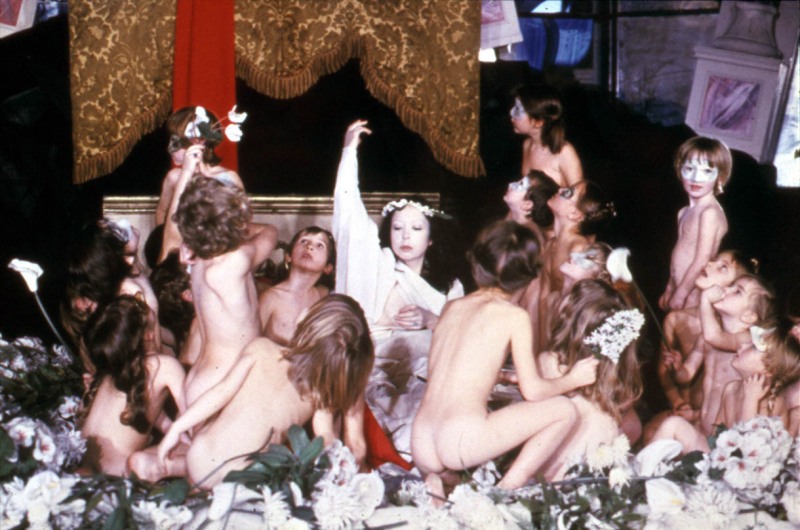
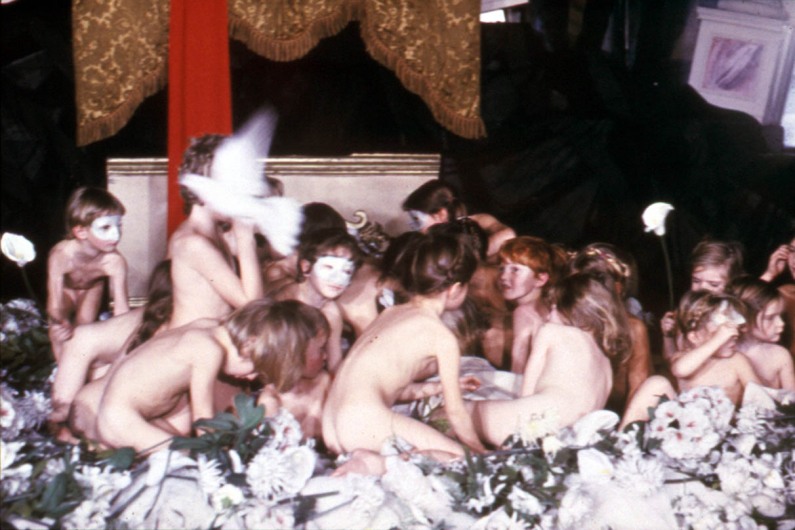
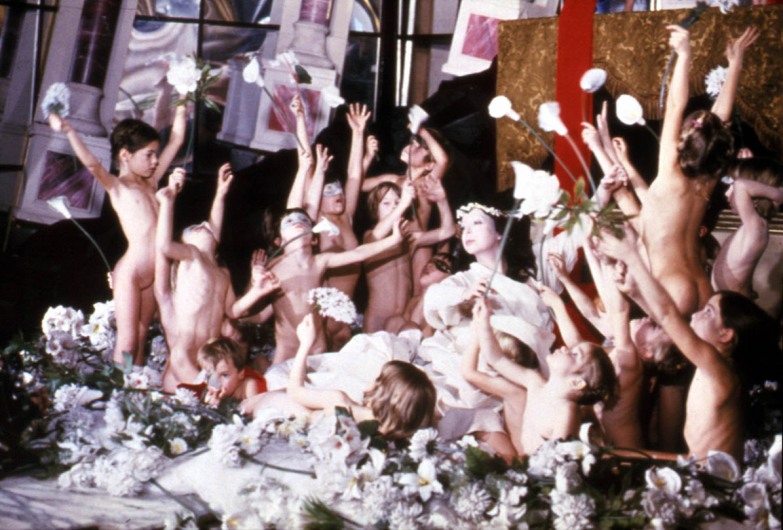
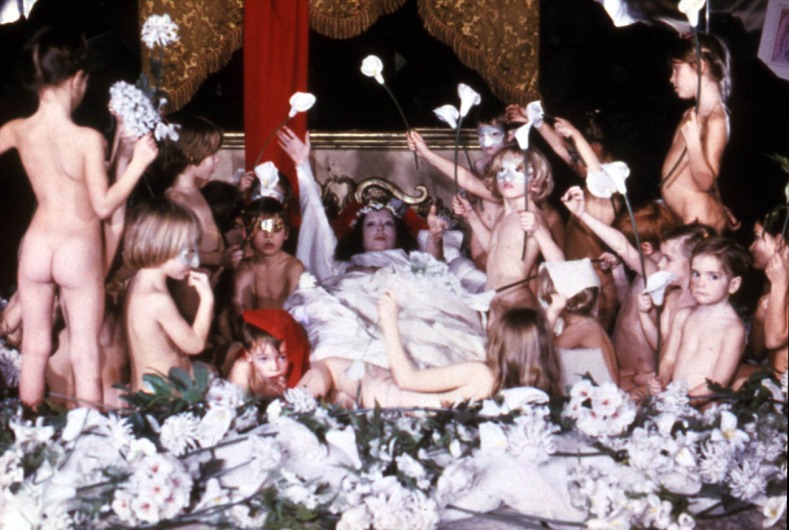
Performance by ORLAN a la colombe, photographed by Pim Schalkwijk Mérida,
2022
no images were found
“Match Selavy,” This Raft (Is Not) Lonely, Mu .ZEE, Ostend, Belgium, 2017
“Match Selavy” was a large-scale public performance organized by Yann Fabre at a soccer stadium in Antwerp. Each of his guests was asked to dress in a way that evoked a figure from art history. ORLAN dressed up as Rose Selavy. When she arrived at the stadium, ORLAN was pleasantly surprised to find museum director Bart de Baere sporting a star-shaped tonsure. They immediately paired up, and while everyone else was trying to kick the ball, ORLAN and Bart de Baere lay on the grass playing chess on the checkered lining of ORLAN’s coat. They also strolled leisurely from one goal to the other, either separately or arm in arm.
no images were found
Petition Against Death, Biennial of Contemporary Art, Kiev, Ukraine, 2017
“A Programmed Breakdown with No Antidote: Until the Death of Death” is the title of Laurent Alexandre’s book; he is a firm believer in “the death of death.” Following his lead, ORLAN invites you to sign her petition against death, available on her website, which states: “Honestly, enough is enough. Enough is enough; we’ve never been asked for our opinion. For millennia, we’ve had to die, others have had to die, our friends and family have had to die. Often in unbearable pain—it’s disgusting. This loss of our faculties, this suffering of being condemned to death. So if we all sign this petition together, we might have a chance. Everyone’s participation is necessary, and that’s the hardest part.”
no images were found
Carte Blanche For Three White Nights, SALÒ #19, SALÒ, Paris, France, April 20,21,22 2017
In 2017, ORLAN was invited by Silencio to take part in the program of their other annex nightclub now called Salò, ( before, the Social Club). Their plan was to give well-known artists carte blanche to design and exhibit a 5-day program. ORLAN invites other artists to showcase their work.
She’s creating an evening that’s all about the vulva! For example, she invited Circé Deslandes, who had sung a torrid lyric entitled “Ta bite debout sur le bar” in a very sweet, gentle voice. ORLAN did a concert with Chicks on Speed. She also invited singers MADMOIZEL and QUEER to take part in the event, as well as female DJs such as Piu Piu and TGAF.
On arrival at the nightclub, people were presented with a mask printed with a photo of ORLAN’s vulva, a reworking of a work created long ago in the video Mise en scène pour un grand fiat (1984), which was shown in full that evening. She also printed the same photo of her vulva, enlarged and cut into strips so that people could pass over and over it as they moved around Salò. ORLAN also exhibited works from the Masques de l’Opéra de Pékin series in several rooms, facing designs and augmented reality, as well as several projected videos.
Tangible Striptease in Nanosequences, Center des Arts, Enghien-les-Bains, Université Paris Diderot, Paris, France,2016
ORLAN performs ” Tangible striptease en nanoséquences” at the Centre des Arts d’Enghien-les-Bains and Université Paris Diderot on Thursday, June 02, 2016 as part of the Bains Numériques festival. She works with Mael Le Mée and Sup’Biotech.
This work is a self-portrait in the form of a biotechnological performance—a snapshot of a biological moment. In this digital and technological experiment, the ORLAN-BODY measures itself against the public’s gaze through the mediation of the bacteria that live in symbiosis within it—co-authors of all human identity. What is now known as the microbiota. The ORLAN-CORPS becomes a public space for the duration of a “nanoscale striptease.” ORLAN then cultivates her oral, vaginal, and intestinal flora.
ORLAN seeks to demonstrate that, for a woman, striptease is “impossible,” because they cannot strip us of all the images that clothe them, all the fantasies, all the beauty standards, and all the preconceptions that cover them up and prevent them from being seen. These are leaden garments that cling to the skin, acting as a screen.
ORLAN-CORPS Project, Survey of Institutions and Streets, M HKA, Antwerp, Belgium, 2012
ORLAN created her MesuRAGE performance series between 1968 and 2017. As the artist’s name is written in all capital letters, the term RAGE emphasizes his refusal to toe the line, to fall in line, and to play the role that society wants to impose on us.
Through these performances, ORLAN used her body as a new instrument of measurement: the ORLAN-BODY. ORLAN applied this principle to measure streets named after historical figures (most of whom, of course, are men, with rare exceptions) and to measure cultural institutions such as the Guggenheim, the Musée Saint-Pierre des Beaux-Arts in Lyon, the Centre Georges Pompidou, the Andy Warhol Museum in Pittsburgh, and the M HKA in Antwerp. ORLAN also measured the Le Corbusier complex in Firminy, the Vatican, and many other sites.
The idea behind this performance was to take Protagoras’s theory that “Man is the measure of all things” and apply it to a pseudo-scientific method of measurement.
The MesuRAGEs protocol is very precise: ORLAN puts on a dress made from the sheets of her trousseau, always the same until it wears out, complete or almost. She has created several installations with the dress between two glass or Plexiglas partitions.
ORLAN measures the determined space with her body by lying on the ground and drawing a chalk line behind her head, then getting down on all fours and moving forward again, lying on her back with her shoes flush with the line. ORLAN counts the number of times her body is contained within this space, and her witnesses count aloud, “One ORLAN-CORPS, two ORLAN-CORPS, three ORLAN-CORPS…”. Then, each of the witnesses signs the report drawn up at the very beginning of the performance on a large sheet of Canson paper attached to a drawing board placed on an easel, and it is finalized by marking the number of ORLANs contained in the space with the signatures of each of the witnesses and ORLAN’s signature.
Then she fetches water, removes her dress and washes it in public. She takes samples of this dirty water into vials, which are then labeled, numbered and sealed with wax to produce an edition with a photo of the finding. ORLAN then exhibits these samples, findings, photographs and videos in galleries and museums, along with commemorative plaques and her life-size effigy with the last pose, like the Statue of Liberty, the dress or the ORLAN-CORPS measuring instrument – all concrete relics, the convinctions of these ephemeral moments.
ORLAN performed *MesuRAGE* at the M HKA in Antwerp in 2017 while wearing a knee brace and taking anti-inflammatory medication due to a knee injury, despite her doctor’s advice against it. For this occasion, ORLAN was the subject of a major retrospective on “MesuRAGE” curated by Barte de Baere, the museum’s director.
She used her body to measure the entire facade of the museum, despite the pain. The result was a series of extraordinary photographs that highlight the architecture of the M HKA, designed by the architectural firm Robbrecht and Daem. Marina Abramovic, a close friend of ORLAN’s who had performed in Antwerp the night before, was present to witness “MesuRAGE,” along with Jan Fabre, Flor Bex, and Barbara de Koening.
ORLAN-CORPS Project, Surveying Institutions and Streets, Andy Warhol Museum, Pittsburgh, United States, 2012
ORLAN created her MesuRAGE performance series between 1968 and 2017. As the artist’s name is written in all capital letters, the term RAGE emphasizes his refusal to toe the line, to fall in line, and to play the role that society wants to impose on us.
Through these performances, ORLAN used her body as a new instrument of measurement: the ORLAN-BODY. ORLAN applied this principle to measure streets named after historical figures (most of whom, of course, are men, with rare exceptions) and to measure cultural institutions such as the Guggenheim, the Musée Saint-Pierre des Beaux-Arts in Lyon, the Centre Georges Pompidou, the Andy Warhol Museum in Pittsburgh, and the M HKA in Antwerp. ORLAN also measured the Le Corbusier complex in Firminy, the Vatican, and many other sites.
The idea behind this performance was to take Protagoras’s theory that “Man is the measure of all things” and apply it to a pseudo-scientific method of measurement.
The MesuRAGEs protocol is very precise: ORLAN puts on a dress made from the sheets of her trousseau, always the same until it wears out, complete or almost. She has created several installations with the dress between two glass or Plexiglas partitions.
ORLAN measures the determined space with her body by lying on the ground and drawing a chalk line behind her head, then getting down on all fours and moving forward again, lying on her back with her shoes flush with the line. ORLAN counts the number of times her body is contained within this space, and her witnesses count aloud, “One ORLAN-CORPS, two ORLAN-CORPS, three ORLAN-CORPS…”. Then, each of the witnesses signs the report drawn up at the very beginning of the performance on a large sheet of Canson paper attached to a drawing board placed on an easel, and it is finalized by marking the number of ORLANs contained in the space with the signatures of each of the witnesses and ORLAN’s signature.
Then she fetches water, removes her dress and washes it in public. She takes samples of this dirty water into vials, which are then labeled, numbered and sealed with wax to produce an edition with a photo of the finding. ORLAN then exhibits these samples, findings, photographs and videos in galleries and museums, along with commemorative plaques and her life-size effigy with the last pose, like the Statue of Liberty, the dress or the ORLAN-CORPS measuring instrument – all concrete relics, the convinctions of these ephemeral moments.
ORLAN performed *MesuRAGE* at the Andy Warhol Museum in Pittsburgh in 2012 while wearing a knee brace and taking anti-inflammatory medication due to a knee injury, despite her doctor’s advice against it. On this occasion, ORLAN was featured in a major retrospective of the MesuRAGE series curated by Eric Shiner.
She used her body to measure the entire facade of the museum, despite the pain.
no images were found
Biopsy, The Harlequin Coat, School of Anatomy and Human Biology, SymbioticA Laboratory, University of Perth, Australia, 2007
In the preface to Tiers-instruit, entitled “Laïcité”, Michel Serres describes the Harlequin who, having gradually removed all his layers of patchwork clothing during a round-the-world tour, presents a skin that is also in patchwork form. ORLAN was greatly inspired by this book, which she will read during the Biopsie performance.
This performance in the form of a medical intervention was realized in 2007, when ORLAN was invited for a three-month residency at the University of Perth in Australia, where they created the SymbioticA laboratory through Oron Catts and Ionat Zurr in the Department of Human Anatomy and Biology, in collaboration with BioArt technician Jens Hauser.
The staging was minimal: around the hospital bed on which ORLAN lay, dressed in harlequin cloth, were two sheets of the same fabric, one velvet and the other satin.
A diamond-shaped incision was made in the groin crease by burn surgeon Fiona Wood.
Following this medical intervention, the installation “Le manteau d’Arlequin” was created.
Lecture: “The Film’s Composition,” Fondation Cartier, Paris, France, 2001
In 1989 and 1992, ORLAN received two grants from FIACRE and the Rhône-Alpes Fund for Artistic and Cultural Innovation to undertake an artist residency in Chennai (then known as Madras), India. On her second trip, which lasted three and a half months, she was accompanied by Stephan Oriach, a filmmaker with whom ORLAN had collaborated in the past.
Her trip to India was part of “the film plan,” a series of works conceived after reading a quote by Jean-Luc Godard: “The only greatness of Jacques Becker’s *Montparnasse 19* is that it is not only a film in reverse, but in a way the reverse of cinema. ” The concept was to take Godard literally, to create a film in reverse, beginning with the poster and promotional materials—including a trailer, flyers, a soundtrack composed by the band Tanger, and a television program for the feature film’s launch. ORLAN enlisted the help of an advertising agency, Publidécor, which specialized in hand-painted movie posters from the 1950s; together, they created fourteen hand-painted posters based on photos of the artist and images of recycled artworks. Her intention with these hand-painted posters—created with acrylic paint on 3 m x 2 m canvases—was to tell the story of her life in art. ORLAN created these posters by featuring the names of her friends in the art world at the time, along with one or two names of movie stars, to make it seem as though the film actually existed. She also staged a fake press conference with the help of director Bigas Luna and exhibition curator Lorand Hegyi during a biennial in Valencia. She invited numerous journalists to tell them about a film she claimed to have made—one that did not actually exist.
ORLAN creates a mock television program recorded live at the Fondation Cartier as part of the Soirées Nomades. Everything seemed real because there was a real TV presenter, Alain Maneval, who with ORLAN asked questions and orchestrated the shoot.
There were also real film directors like Richard Dembo, as well as many actors and actresses, Sylvie Testud, Jean-Claude Dreyfus, Jean-Christophe Bouvet…film and art critics like Christine Buci-Glucksmann and artists like Raymond Hains.
ORLAN recreated a fake TV set and projected the movie posters. Each of the actors and actresses seemed to have just come out of the premiere, telling the story of the film, the story of the shoot and their relationship with the cast and crew.
In 1997, ORLAN wanted to work with the forensic police on DNA sequencing, which had just been used to solve criminal cases.
The “Exogène” exhibition, created by Bruno Guiganti and Morten Salling, took the form of a multi-part criminal investigation and identity quest. Works created by ORLAN using her own blood and flesh have been submitted to the Danish forensic police for sequencing to verify whether they were created by the same artist. Sequencing analysis proved that they had indeed been produced by ORLAN. These works were a reliquary with flesh in the center and a St suaires soaked in ORLAN’s blood.
This fiction within a fiction spread throughout Copenhagen. Wanted posters featuring ORLAN were then put up all over the city, and a skull supposedly found by the art center was handed over to the criminal investigation department to find out if it might belong to her.
Traces of this investigation (works by ORLAN, fingerprints, DNA sequencing, wanted notices, skulls, etc.) were then exhibited in the desecrated Nikolaj Church, transformed into an art center.
“Woman with Head(s),” Institute of Contemporary Art, London, United Kingdom, 1996
There are certain physical transformations that not even ORLAN can achieve without the help of magic. In Femme avec tête(s) (Woman with head(s)), an absolute counterpoint to images that chosify women by reducing them to their sexual attributes, she tackles the mind/body problem with her characteristic sense of humor. In this performance, staged at the ICA in London, ORLAN takes on her detractors head on. She collaborated with a magician who made her body disappear, leaving only her head. 9She answers questions posed by her own video image, such as “ORLAN, are you a copy or the original? Do you believe in God? Are you crazy?” by reading aloud texts by Antonin Artaud, Julia Kristeva, Eugénie Lemoine-Luccioni and Michel Serres, who inspired her to make her body “a place for public debate”.
no images were found
The Reincarnation of Sainte-ORLAN, or New Images—Images / 9th Surgical Performance, December 14, 1993
In June 1989, some British curators who had seen ORLAN’s performances at the Centre Pompidou during an event centered on Fluxus and Happenings invited her to participate in their Edge festival (May 22–30, 1990) by creating a work on the theme “Art and Life in the 1990s.”
One could say, then, that this is a commissioned performance. In this proposal, she found a way to speak out loud and clear about how negatively she viewed artistic production in the 1980s. She therefore decided to stage a performance that went against the grain, serving as a counterpoint to what was happening in the contemporary art scene. In those years, most artists had become completely conformist and overly accommodating to market forces. ORLAN wanted to create a performance that built on her previous work—one that looked toward the future, radical in and of itself and transcending her own persona.
It was while reading *La Robe* (which she would use as a motto for all her surgical-performance operations) by Eugénie Lemoine-Luccioni, a Lacanian psychoanalyst, that the idea of this “passage à l’acte” occurred to her. She thought that at that time they were beginning to have the means to bridge the gap between the internal image and the external image. She then said that she was engaging in “woman-to-woman transsexualism,” alluding to transsexuals: a man who feels like a woman wants others to see him as a woman (and vice versa). We could summarize this by saying that it is a communication problem. ORLAN creates a classic self-portrait, initially developed using a computer and then permanently inscribed on her flesh. She refers to this as “carnal art” to distinguish it from body art and questions the status of the body in society and its future in coming generations through new technologies and genetic manipulation.
The artist’s body becomes a venue for public debate.
On May 30, 1990, ORLAN’s birthday, in a deconsecrated church called “All Saints” in Newcastle, England, she announced, during an inaugural ritual performance, her decision to undertake the Surgical-Performance Operations by reading her “Carnal Art” manifesto, which she had written in 1989.
The series has two titles: The Reincarnation of Sainte-ORLAN (a reference to the character who gradually came into being by adopting religious imagery in his major series Documentary Study: The Drapery, The Baroque) or “new images—images” (A nod to the Hindu gods and goddesses who change their appearance to undertake new works and achieve new feats. For ORLAN, this involves shifting her frame of reference—moving from Judeo-Christian religious iconography to Greek mythology. Furthermore, this second title alludes to the so-called “new images,” that is, new technologies.) It is a series of nine performances created by ORLAN between 1990 and 1993 in Paris, Brussels, and New York.
In the very beginning, ORLAN created a self-portrait by mixing and blending, using a computer, images of goddesses from Greek mythology—chosen not for the beauty standards they are supposed to represent, but rather for their stories.
Diane was chosen because she defies both gods and men, because she is proactive—even aggressive—and because she leads a group. The Mona Lisa as a flagship figure in art history, as a point of reference, because she isn’t beautiful by today’s standards of beauty, because there is a man hidden beneath this woman. We now know that it is Leonardo da Vinci’s self-portrait that lies hidden beneath the Mona Lisa (which brings us back to the issue of identity).
ORLAN will say:
“ISo I don’t want to look like Botticelli’s Venus.
I don’t want to look like Gustave Moreau’s Europa (who isn’t my favorite painter). I chose this painter’s depiction of Europa because she appears in an unfinished painting—as, in fact, do most of his paintings!
I don’t want to look like Gérard’s Psyche.
I don’t want to look like Diane from the Fontainebleau School.
I don’t want to look like Leonardo da Vinci’s Mona Lisa… as some newspapers and television shows have said and continue to say, despite my many contradictions and outbursts of anger. (The media coverage I can’t escape—whether in print or on television—will be analyzed and understood in about ten years. ”
For ORLAN, these depictions of female figures serve as a framework and a source of inspiration, and are symbolically far below them. Through this process of digital hybridization, she asked the surgeons to come as close as possible to this image.
In the three most recent surgical procedures performed in New York, ORLAN has broken free from conventional models by carrying out operations that were not intended to create beauty but rather ugliness and monstrosity.
At first, finding a surgeon was difficult. After many rejections, ORLAN found one—a very cautious surgeon who started by taking small steps, which allowed her to understand what she was getting into and to assess what she could manage to do in an operating room, what the limitations were and her own limits, understand how she reacted, how her body reacted, and thus learn to manage the entire surgical process better and better.
ORLAN created this series to disrupt the conventional practices of cosmetic surgery aimed at enhancement and rejuvenation. ORLAN is not against cosmetic surgery itself, but rather against the way it is used. She thus uses this technique to create a form of self-love by challenging the mask of the “natural.” The primary condition agreed upon with the various surgeons was that there be no pain, as ORLAN advocates for BODY-PLEASURE.
Each procedure was conceived as a rite of passage. As a visual artist, ORLAN sought to intervene in the cold, stereotypical aesthetics of surgery and transform them. For each performance, ORLAN decorated the operating room, which, through this act, became her artist’s studio. She and the entire medical team were dressed by a renowned designer who collaborated with the artist. The performances were accompanied by readings, and whenever the surgical procedure allowed, ORLAN produced images—making films, videos, photographs, and drawings—using her blood and fingers, reliquaries made from her fat and flesh, a sort of “holy shroud” created from her dried blood and medical gauze from the operation—onto which she made photographic transfers—and objects that were subsequently exhibited in museums and galleries.
The 9th Surgical Performance took place on December 14, 1993, in New York in collaboration with the Sandra Gering Gallery. During this performance, ORLAN underwent surgery performed by feminist surgeon Dr. Marjorie Kramer, who inserted the largest implants possible for her anatomy. Only one was rejected by ORLAN’s body, and she was dressed by Lan Vu and her team.The photographers were Robert Puglisi and Vladimir Sichov for Pipa-Press. ORLAN then decorated the operating room with a bright yellow fabric that matched the surgeon’s scrubs.
no images were found
The Reincarnation of Sainte-ORLAN, or New Images-Images / 7thSurgical-Performance Operation, titled “Omnipresence,” November 21, 1993
In June 1989, some British curators who had seen ORLAN’s performances at the Centre Pompidou during an event centered on Fluxus and Happenings invited her to participate in their Edge festival (May 22–30, 1990) by creating a work on the theme “Art and Life in the 1990s.”
One could say, then, that this is a commissioned performance. In this proposal, she found a way to speak out loud and clear about how negatively she viewed artistic production in the 1980s. She therefore decided to stage a performance that went against the grain, serving as a counterpoint to what was happening in the contemporary art scene. In those years, most artists had become completely conformist and overly accommodating to market forces. ORLAN wanted to create a performance that built on her previous work—one that looked toward the future, radical in and of itself and transcending her own persona.
It was while reading *La Robe* (which she would use as a motto for all her surgical-performance operations) by Eugénie Lemoine-Luccioni, a Lacanian psychoanalyst, that the idea of this “passage à l’acte” occurred to her. She thought that at that time they were beginning to have the means to bridge the gap between the internal image and the external image. She then said that she was engaging in “woman-to-woman transsexualism,” alluding to transsexuals: a man who feels like a woman wants others to see him as a woman (and vice versa). We could summarize this by saying that it is a communication problem. ORLAN creates a classic self-portrait, initially developed using a computer and then permanently inscribed on her flesh. She refers to this as “carnal art” to distinguish it from body art and questions the status of the body in society and its future in coming generations through new technologies and genetic manipulation.
The artist’s body becomes a venue for public debate.
On May 30, 1990, ORLAN’s birthday, in a deconsecrated church called “All Saints” in Newcastle, England, she announced, during an inaugural ritual performance, her decision to undertake the Surgical-Performance Operations by reading her “Carnal Art” manifesto, which she had written in 1989.
The series has two titles: The Reincarnation of Sainte-ORLAN (a reference to the character who gradually came into being by adopting religious imagery in his major series Documentary Study: The Drapery, The Baroque) or “new images—images” (A nod to the Hindu gods and goddesses who change their appearance to undertake new works and achieve new feats. For ORLAN, this involves shifting her frame of reference—moving from Judeo-Christian religious iconography to Greek mythology. Furthermore, this second title alludes to the so-called “new images,” that is, new technologies.) It is a series of nine performances created by ORLAN between 1990 and 1993 in Paris, Brussels, and New York.
In the very beginning, ORLAN created a self-portrait by mixing and blending, using a computer, images of goddesses from Greek mythology—chosen not for the beauty standards they are supposed to represent, but rather for their stories.
Diane was chosen because she defies both gods and men, because she is proactive—even aggressive—and because she leads a group. The Mona Lisa as a flagship figure in art history, as a point of reference, because she isn’t beautiful by today’s standards of beauty, because there is a man hidden beneath this woman. We now know that it is Leonardo da Vinci’s self-portrait that lies hidden beneath the Mona Lisa (which brings us back to the issue of identity).
ORLAN will say:
“ISo I don’t want to look like Botticelli’s Venus.
I don’t want to look like Gustave Moreau’s Europa (who isn’t my favorite painter). I chose this painter’s depiction of Europa because she appears in an unfinished painting—as, in fact, do most of his paintings!
I don’t want to look like Gérard’s Psyche.
I don’t want to look like Diane from the Fontainebleau School.
I don’t want to look like Leonardo da Vinci’s Mona Lisa… as some newspapers and television shows have said and continue to say, despite my many contradictions and outbursts of anger. (The media coverage I can’t escape—whether in print or on television—will be analyzed and understood in about ten years. ”
For ORLAN, these depictions of female figures serve as a framework and a source of inspiration, and are symbolically far below them. Through this process of digital hybridization, she asked the surgeons to come as close as possible to this image.
In the three most recent surgical procedures performed in New York, ORLAN has broken free from conventional models by carrying out operations that were not intended to create beauty but rather ugliness and monstrosity.
At first, finding a surgeon was difficult. After many rejections, ORLAN found one—a very cautious surgeon who started by taking small steps, which allowed her to understand what she was getting into and to assess what she could manage to do in an operating room, what the limitations were and her own limits, understand how she reacted, how her body reacted, and thus learn to manage the entire surgical process better and better.
ORLAN created this series to disrupt the conventional practices of cosmetic surgery aimed at enhancement and rejuvenation. ORLAN is not against cosmetic surgery itself, but rather against the way it is used. She thus uses this technique to create a form of self-love by challenging the mask of the “natural.” The primary condition agreed upon with the various surgeons was that there be no pain, as ORLAN advocates for BODY-PLEASURE.
Each procedure was conceived as a rite of passage. As a visual artist, ORLAN sought to intervene in the cold, stereotypical aesthetics of surgery and transform them. For each performance, ORLAN decorated the operating room, which, through this act, became her artist’s studio. She and the entire medical team were dressed by a renowned designer who collaborated with the artist. The performances were accompanied by readings, and whenever the surgical procedure allowed, ORLAN produced images—making films, videos, photographs, and drawings—using her blood and fingers, reliquaries made from her fat and flesh, a sort of “holy shroud” created from her dried blood and medical gauze from the operation—onto which she made photographic transfers—and objects that were subsequently exhibited in museums and galleries.
The 7th surgical operation-performance, known as Omniprésence, took place on November 21 1993 in New York in collaboration with the Sandra Gering Gallery.
During this operation, ORLAN was operated on by the feminist surgeon Dr. Marjorie Kramer and costumed by designer Lan Vu and her team. The photographers were Robert Puglisi and Vladimir Sichov for Sipa-Press (photos copyright-free).
Among the medical team and the STUDIO ORLAN team, there was a woman specializing in sign language for the deaf and hard-of-hearing, and this character was there to remind us that we are all at times deaf and hard-of-hearing. His presence in the operating theatre was a display of body language. She was assisted by Raphaël Cuir, videographer Tom Klinkowstein, who handled the satellite transmission, Sophie Thompson, who took care of the English translation, and Connie Chung, the famous star broadcaster of the time, who asked to be in the operating room with ORLAN and did a full report on the CNN evening news at 8pm. She came to France to attend ORLAN’s wedding to Raphaël Cuir in Sologne.
During this mythical operation, ORLAN had solid silicone implants placed on her cheekbones to enhance them on both sides of her forehead. The idea was to create an operation that wouldn’t bring beauty but, on the contrary, undesirability and monstrosity. ORLAN wanted to demonstrate that beauty is a dictate of the dominant ideology in a geographical and historical point in time. These bumps have become organs of seduction. ORLAN says “it’s my convertible”.
Thanks to Christian Vanderborght, this performance was broadcast live via satellite to the Centre Georges Pompidou in Paris, the Mac Luhan Centre in Toronto, the Banff Multimedia Centre, Canada, Belgium, Germany, Latvia, Japan, the Netherlands, New York, Santa Monica and in France to Nice and Lyon. Spectators from all over the world were able to watch the operation and ask questions, which ORLAN answered live as soon as the surgical procedure allowed. Participants in the satellite transmission at the Centre Georges Pompidou included Gladys Fabre, Jean-Paul Fargier, Christian Vanderborght and François Barré, President of the Centre, among others.
The Reincarnation of Sainte-ORLAN, or Images—New Images / 6th Surgical Performance at the Circus Miscellaneous in Liège, known as “Body Without Organs,” Belgium, February 1992
In June 1989, some British curators who had seen ORLAN’s performances at the Centre Pompidou during an event centered on Fluxus and Happenings invited her to participate in their Edge festival (May 22–30, 1990) by creating a work on the theme “Art and Life in the 1990s.”
One could say, then, that this is a commissioned performance. In this proposal, she found a way to speak out loud and clear about how negatively she viewed artistic production in the 1980s. She therefore decided to stage a performance that went against the grain, serving as a counterpoint to what was happening in the contemporary art scene. In those years, most artists had become completely conformist and overly accommodating to market forces. ORLAN wanted to create a performance that built on her previous work—one that looked toward the future, radical in and of itself and transcending her own persona.
It was while reading *La Robe* (which she would use as a motto for all her surgical-performance operations) by Eugénie Lemoine-Luccioni, a Lacanian psychoanalyst, that the idea of this “passage à l’acte” occurred to her. She thought that at that time they were beginning to have the means to bridge the gap between the internal image and the external image. She then said that she was engaging in “woman-to-woman transsexualism,” alluding to transsexuals: a man who feels like a woman wants others to see him as a woman (and vice versa). We could summarize this by saying that it is a communication problem. ORLAN creates a classic self-portrait, initially developed using a computer and then permanently inscribed on her flesh. She refers to this as “carnal art” to distinguish it from body art and questions the status of the body in society and its future in coming generations through new technologies and genetic manipulation.
The artist’s body becomes a venue for public debate.
On May 30, 1990, ORLAN’s birthday, in a deconsecrated church called “All Saints” in Newcastle, England, she announced, during an inaugural ritual performance, her decision to undertake the Surgical-Performance Operations by reading her “Carnal Art” manifesto, which she had written in 1989.
The series has two titles: The Reincarnation of Sainte-ORLAN (a reference to the character who gradually came into being by adopting religious imagery in his major series Documentary Study: The Drapery, The Baroque) or “new images—images” (A nod to the Hindu gods and goddesses who change their appearance to undertake new works and achieve new feats. For ORLAN, this involves shifting her frame of reference—moving from Judeo-Christian religious iconography to Greek mythology. Furthermore, this second title alludes to the so-called “new images,” that is, new technologies.) It is a series of nine performances created by ORLAN between 1990 and 1993 in Paris, Brussels, and New York.
In the very beginning, ORLAN created a self-portrait by mixing and blending, using a computer, images of goddesses from Greek mythology—chosen not for the beauty standards they are supposed to represent, but rather for their stories.
Diane was chosen because she defies both gods and men, because she is proactive—even aggressive—and because she leads a group. The Mona Lisa as a flagship figure in art history, as a point of reference, because she isn’t beautiful by today’s standards of beauty, because there is a man hidden beneath this woman. We now know that it is Leonardo da Vinci’s self-portrait that lies hidden beneath the Mona Lisa (which brings us back to the issue of identity).
ORLAN will say:
“ISo I don’t want to look like Botticelli’s Venus.
I don’t want to look like Gustave Moreau’s Europa (who isn’t my favorite painter). I chose this painter’s depiction of Europa because she appears in an unfinished painting—as, in fact, do most of his paintings!
I don’t want to look like Gérard’s Psyche.
I don’t want to look like Diane from the Fontainebleau School.
I don’t want to look like Leonardo da Vinci’s Mona Lisa… as some newspapers and television shows have said and continue to say, despite my many contradictions and outbursts of anger. (The media coverage I can’t escape—whether in print or on television—will be analyzed and understood in about ten years. ”
For ORLAN, these depictions of female figures serve as a framework and a source of inspiration, and are symbolically far below them. Through this process of digital hybridization, she asked the surgeons to come as close as possible to this image.
In the three most recent surgical procedures performed in New York, ORLAN has broken free from conventional models by carrying out operations that were not intended to create beauty but rather ugliness and monstrosity.
At first, finding a surgeon was difficult. After many rejections, ORLAN found one—a very cautious surgeon who started by taking small steps, which allowed her to understand what she was getting into and to assess what she could manage to do in an operating room, what the limitations were and her own limits, understand how she reacted, how her body reacted, and thus learn to manage the entire surgical process better and better.
ORLAN created this series to disrupt the conventional practices of cosmetic surgery aimed at enhancement and rejuvenation. ORLAN is not against cosmetic surgery itself, but rather against the way it is used. She thus uses this technique to create a form of self-love by challenging the mask of the “natural.” The primary condition agreed upon with the various surgeons was that there be no pain, as ORLAN advocates for BODY-PLEASURE.
Each procedure was conceived as a rite of passage. As a visual artist, ORLAN sought to intervene in the cold, stereotypical aesthetics of surgery and transform them. For each performance, ORLAN decorated the operating room, which, through this act, became her artist’s studio. She and the entire medical team were dressed by a renowned designer who collaborated with the artist. The performances were accompanied by readings, and whenever the surgical procedure allowed, ORLAN produced images—making films, videos, photographs, and drawings—using her blood and fingers, reliquaries made from her fat and flesh, a sort of “holy shroud” created from her dried blood and medical gauze from the operation—onto which she made photographic transfers—and objects that were subsequently exhibited in museums and galleries.
The sixth surgical performance took place in February 1992 as part of a performance festival in Liège, and took its title from *Corps sans organes* from Antonin Artaud. Artaud’s text is recited, while three skulls lend a more somber tone to the setting of this living “vanity.” ORLAN wears a faux leopard-print fur hat and plays with her plastic props (skulls, a cross, and a pitchfork). The surgeon performs liposuction on her face and abdomen.
no images were found
The Reincarnation of Sainte-ORLAN, or Images-New Images / 5th Surgical-Performance Operation, known as “Opération Opéra,” February 1991
In June 1989, some British curators who had seen ORLAN’s performances at the Centre Pompidou during an event centered on Fluxus and Happenings invited her to participate in their Edge festival (May 22–30, 1990) by creating a work on the theme “Art and Life in the 1990s.”
One could say, then, that this is a commissioned performance. In this proposal, she found a way to speak out loud and clear about how negatively she viewed artistic production in the 1980s. She therefore decided to stage a performance that went against the grain, serving as a counterpoint to what was happening in the contemporary art scene. In those years, most artists had become completely conformist and overly accommodating to market forces. ORLAN wanted to create a performance that built on her previous work—one that looked toward the future, radical in and of itself and transcending her own persona.
It was while reading *La Robe* (which she would use as a motto for all her surgical-performance operations) by Eugénie Lemoine-Luccioni, a Lacanian psychoanalyst, that the idea of this “passage à l’acte” occurred to her. She thought that at that time they were beginning to have the means to bridge the gap between the internal image and the external image. She then said that she was engaging in “woman-to-woman transsexualism,” alluding to transsexuals: a man who feels like a woman wants others to see him as a woman (and vice versa). We could summarize this by saying that it is a communication problem. ORLAN creates a classic self-portrait, initially developed using a computer and then permanently inscribed on her flesh. She refers to this as “carnal art” to distinguish it from body art and questions the status of the body in society and its future in coming generations through new technologies and genetic manipulation.
The artist’s body becomes a venue for public debate.
On May 30, 1990, ORLAN’s birthday, in a deconsecrated church called “All Saints” in Newcastle, England, she announced, during an inaugural ritual performance, her decision to undertake the Surgical-Performance Operations by reading her “Carnal Art” manifesto, which she had written in 1989.
The series has two titles: The Reincarnation of Sainte-ORLAN (a reference to the character who gradually came into being by adopting religious imagery in his major series Documentary Study: The Drapery, The Baroque) or “new images—images” (A nod to the Hindu gods and goddesses who change their appearance to undertake new works and achieve new feats. For ORLAN, this involves shifting her frame of reference—moving from Judeo-Christian religious iconography to Greek mythology. Furthermore, this second title alludes to the so-called “new images,” that is, new technologies.) It is a series of nine performances created by ORLAN between 1990 and 1993 in Paris, Brussels, and New York.
In the very beginning, ORLAN created a self-portrait by mixing and blending, using a computer, images of goddesses from Greek mythology—chosen not for the beauty standards they are supposed to represent, but rather for their stories.
Diane was chosen because she defies both gods and men, because she is proactive—even aggressive—and because she leads a group. The Mona Lisa as a flagship figure in art history, as a point of reference, because she isn’t beautiful by today’s standards of beauty, because there is a man hidden beneath this woman. We now know that it is Leonardo da Vinci’s self-portrait that lies hidden beneath the Mona Lisa (which brings us back to the issue of identity).
ORLAN will say:
“ISo I don’t want to look like Botticelli’s Venus.
I don’t want to look like Gustave Moreau’s Europa (who isn’t my favorite painter). I chose this painter’s depiction of Europa because she appears in an unfinished painting—as, in fact, do most of his paintings!
I don’t want to look like Gérard’s Psyche.
I don’t want to look like Diane from the Fontainebleau School.
I don’t want to look like Leonardo da Vinci’s Mona Lisa… as some newspapers and television shows have said and continue to say, despite my many contradictions and outbursts of anger. (The media coverage I can’t escape—whether in print or on television—will be analyzed and understood in about ten years. ”
For ORLAN, these depictions of female figures serve as a framework and a source of inspiration, and are symbolically far below them. Through this process of digital hybridization, she asked the surgeons to come as close as possible to this image.
In the three most recent surgical procedures performed in New York, ORLAN has broken free from conventional models by carrying out operations that were not intended to create beauty but rather ugliness and monstrosity.
At first, finding a surgeon was difficult. After many rejections, ORLAN found one—a very cautious surgeon who started by taking small steps, which allowed her to understand what she was getting into and to assess what she could manage to do in an operating room, what the limitations were and her own limits, understand how she reacted, how her body reacted, and thus learn to manage the entire surgical process better and better.
ORLAN created this series to disrupt the conventional practices of cosmetic surgery aimed at enhancement and rejuvenation. ORLAN is not against cosmetic surgery itself, but rather against the way it is used. She thus uses this technique to create a form of self-love by challenging the mask of the “natural.” The primary condition agreed upon with the various surgeons was that there be no pain, as ORLAN advocates for BODY-PLEASURE.
Each procedure was conceived as a rite of passage. As a visual artist, ORLAN sought to intervene in the cold, stereotypical aesthetics of surgery and transform them. For each performance, ORLAN decorated the operating room, which, through this act, became her artist’s studio. She and the entire medical team were dressed by a renowned designer who collaborated with the artist. The performances were accompanied by readings, and whenever the surgical procedure allowed, ORLAN produced images—making films, videos, photographs, and drawings—using her blood and fingers, reliquaries made from her fat and flesh, a sort of “holy shroud” created from her dried blood and medical gauze from the operation—onto which she made photographic transfers—and objects that were subsequently exhibited in museums and galleries.
The 5th operation-surgical-performance, known as Operation-Opera, took place on July 06, 1991 in Paris.
During this operation, ORLAN was operated on by Dr. Bernard Cornette de Saint-Cyr and dressed by fashion designer Franck Sorbier.
ORLAN complements the reading of *La Robe* with an excerpt from Michel Serres’ book *Le Tiers instruit*, engraved twenty times, in twenty different languages, on glass plates to which are attached containers holding twenty-gram portions of Orlan’s flesh: “The running monster—tattooed, ambidextrous, hermaphroditic, and mixed-race—what might it show us now, beneath its skin? Yes, blood and flesh! This text serves as the ‘libretto’ for an opera sung and danced by Jimmy Blanche. This performance served as the starting point for a ceiling-mounted video installation presented at the Sydney Biennale in 1992. Videograms, featuring images superimposed within a cross, are paired with Christ’s words during the Passion: “A little while longer and you will no longer see me; a little while longer and you will see me again.”
no images were found
The Reincarnation of Sainte-ORLAN, or Images—New Images / 4th Surgical Performance, known as “Successful Operation,” December 8, 1990
In June 1989, some British curators who had seen ORLAN’s performances at the Centre Pompidou during an event centered on Fluxus and Happenings invited her to participate in their Edge festival (May 22–30, 1990) by creating a work on the theme “Art and Life in the 1990s.”
One could say, then, that this is a commissioned performance. In this proposal, she found a way to speak out loud and clear about how negatively she viewed artistic production in the 1980s. She therefore decided to stage a performance that went against the grain, serving as a counterpoint to what was happening in the contemporary art scene. In those years, most artists had become completely conformist and overly accommodating to market forces. ORLAN wanted to create a performance that built on her previous work—one that looked toward the future, radical in and of itself and transcending her own persona.
It was while reading *La Robe* (which she would use as a motto for all her surgical-performance operations) by Eugénie Lemoine-Luccioni, a Lacanian psychoanalyst, that the idea of this “passage à l’acte” occurred to her. She thought that at that time they were beginning to have the means to bridge the gap between the internal image and the external image. She then said that she was engaging in “woman-to-woman transsexualism,” alluding to transsexuals: a man who feels like a woman wants others to see him as a woman (and vice versa). We could summarize this by saying that it is a communication problem. ORLAN creates a classic self-portrait, initially developed using a computer and then permanently inscribed on her flesh. She refers to this as “carnal art” to distinguish it from body art and questions the status of the body in society and its future in coming generations through new technologies and genetic manipulation.
The artist’s body becomes a venue for public debate.
On May 30, 1990, ORLAN’s birthday, in a deconsecrated church called “All Saints” in Newcastle, England, she announced, during an inaugural ritual performance, her decision to undertake the Surgical-Performance Operations by reading her “Carnal Art” manifesto, which she had written in 1989.
The series has two titles: The Reincarnation of Sainte-ORLAN (a reference to the character who gradually came into being by adopting religious imagery in his major series Documentary Study: The Drapery, The Baroque) or “new images—images” (A nod to the Hindu gods and goddesses who change their appearance to undertake new works and achieve new feats. For ORLAN, this involves shifting her frame of reference—moving from Judeo-Christian religious iconography to Greek mythology. Furthermore, this second title alludes to the so-called “new images,” that is, new technologies.) It is a series of nine performances created by ORLAN between 1990 and 1993 in Paris, Brussels, and New York.
In the very beginning, ORLAN created a self-portrait by mixing and blending, using a computer, images of goddesses from Greek mythology—chosen not for the beauty standards they are supposed to represent, but rather for their stories.
Diane was chosen because she defies both gods and men, because she is proactive—even aggressive—and because she leads a group. The Mona Lisa as a flagship figure in art history, as a point of reference, because she isn’t beautiful by today’s standards of beauty, because there is a man hidden beneath this woman. We now know that it is Leonardo da Vinci’s self-portrait that lies hidden beneath the Mona Lisa (which brings us back to the issue of identity).
ORLAN will say:
“ISo I don’t want to look like Botticelli’s Venus.
I don’t want to look like Gustave Moreau’s Europa (who isn’t my favorite painter). I chose this painter’s depiction of Europa because she appears in an unfinished painting—as, in fact, do most of his paintings!
I don’t want to look like Gérard’s Psyche.
I don’t want to look like Diane from the Fontainebleau School.
I don’t want to look like Leonardo da Vinci’s Mona Lisa… as some newspapers and television shows have said and continue to say, despite my many contradictions and outbursts of anger. (The media coverage I can’t escape—whether in print or on television—will be analyzed and understood in about ten years. ”
For ORLAN, these depictions of female figures serve as a framework and a source of inspiration, and are symbolically far below them. Through this process of digital hybridization, she asked the surgeons to come as close as possible to this image.
In the three most recent surgical procedures performed in New York, ORLAN has broken free from conventional models by carrying out operations that were not intended to create beauty but rather ugliness and monstrosity.
At first, finding a surgeon was difficult. After many rejections, ORLAN found one—a very cautious surgeon who started by taking small steps, which allowed her to understand what she was getting into and to assess what she could manage to do in an operating room, what the limitations were and her own limits, understand how she reacted, how her body reacted, and thus learn to manage the entire surgical process better and better.
ORLAN created this series to disrupt the conventional practices of cosmetic surgery aimed at enhancement and rejuvenation. ORLAN is not against cosmetic surgery itself, but rather against the way it is used. She thus uses this technique to create a form of self-love by challenging the mask of the “natural.” The primary condition agreed upon with the various surgeons was that there be no pain, as ORLAN advocates for BODY-PLEASURE.
Each procedure was conceived as a rite of passage. As a visual artist, ORLAN sought to intervene in the cold, stereotypical aesthetics of surgery and transform them. For each performance, ORLAN decorated the operating room, which, through this act, became her artist’s studio. She and the entire medical team were dressed by a renowned designer who collaborated with the artist. The performances were accompanied by readings, and whenever the surgical procedure allowed, ORLAN produced images—making films, videos, photographs, and drawings—using her blood and fingers, reliquaries made from her fat and flesh, a sort of “holy shroud” created from her dried blood and medical gauze from the operation—onto which she made photographic transfers—and objects that were subsequently exhibited in museums and galleries.
The fourth surgical performance, known as “Operation Successful” or “The Ultimate Masterpiece,” took place on December 8, 1990, in Paris.
During this operation, ORLAN underwent surgery performed by Dr. Bernard Cornette de Saint-Cyr and was dressed by fashion designer Paco Rabanne.
During the performance, the artist read “La Robe” by Eugénie Lemoine-Luccioni and Lacan. The photographer was Alain Dohmé for Pipa-Press. ORLAN decorated the operating room with a huge movie poster painted in acrylic, an image of “Sein unique.” A phallic display, trompe-l’œil marble basins, and an abundance of flowers. ORLAN plays with these props—fruits and vegetables, two plastic lobsters, as well as the two crosses, one black and one white, made of beads from her series Skai and sky and a video.
no images were found
The Reincarnation of Sainte-ORLAN, or New Images-Images / 2ndSurgical Performance Known as “The Sheriff’s Operating Room,” July 20, 1990
In June 1989, some British curators who had seen ORLAN’s performances at the Centre Pompidou during an event centered on Fluxus and Happenings invited her to participate in their Edge festival (May 22–30, 1990) by creating a work on the theme “Art and Life in the 1990s.”
One could say, then, that this is a commissioned performance. In this proposal, she found a way to speak out loud and clear about how negatively she viewed artistic production in the 1980s. She therefore decided to stage a performance that went against the grain, serving as a counterpoint to what was happening in the contemporary art scene. In those years, most artists had become completely conformist and overly accommodating to market forces. ORLAN wanted to create a performance that built on her previous work—one that looked toward the future, radical in and of itself and transcending her own persona.
It was while reading *La Robe* (which she would use as a motto for all her surgical-performance operations) by Eugénie Lemoine-Luccioni, a Lacanian psychoanalyst, that the idea of this “passage à l’acte” occurred to her. She thought that at that time they were beginning to have the means to bridge the gap between the internal image and the external image. She then said that she was engaging in “woman-to-woman transsexualism,” alluding to transsexuals: a man who feels like a woman wants others to see him as a woman (and vice versa). We could summarize this by saying that it is a communication problem. ORLAN creates a classic self-portrait, initially developed using a computer and then permanently inscribed on her flesh. She refers to this as “carnal art” to distinguish it from body art and questions the status of the body in society and its future in coming generations through new technologies and genetic manipulation.
The artist’s body becomes a venue for public debate.
On May 30, 1990, ORLAN’s birthday, in a deconsecrated church called “All Saints” in Newcastle, England, she announced, during an inaugural ritual performance, her decision to undertake the Surgical-Performance Operations by reading her “Carnal Art” manifesto, which she had written in 1989.
The series has two titles: The Reincarnation of Sainte-ORLAN (a reference to the character who gradually came into being by adopting religious imagery in his major series Documentary Study: The Drapery, The Baroque) or “new images—images” (A nod to the Hindu gods and goddesses who change their appearance to undertake new works and achieve new feats. For ORLAN, this involves shifting her frame of reference—moving from Judeo-Christian religious iconography to Greek mythology. Furthermore, this second title alludes to the so-called “new images,” that is, new technologies.) It is a series of nine performances created by ORLAN between 1990 and 1993 in Paris, Brussels, and New York.
In the very beginning, ORLAN created a self-portrait by mixing and blending, using a computer, images of goddesses from Greek mythology—chosen not for the beauty standards they are supposed to represent, but rather for their stories.
Diane was chosen because she defies both gods and men, because she is proactive—even aggressive—and because she leads a group. The Mona Lisa as a flagship figure in art history, as a point of reference, because she isn’t beautiful by today’s standards of beauty, because there is a man hidden beneath this woman. We now know that it is Leonardo da Vinci’s self-portrait that lies hidden beneath the Mona Lisa (which brings us back to the issue of identity).
ORLAN will say:
“ISo I don’t want to look like Botticelli’s Venus.
I don’t want to look like Gustave Moreau’s Europa (who isn’t my favorite painter). I chose this painter’s depiction of Europa because she appears in an unfinished painting—as, in fact, do most of his paintings!
I don’t want to look like Gérard’s Psyche.
I don’t want to look like Diane from the Fontainebleau School.
I don’t want to look like Leonardo da Vinci’s Mona Lisa… as some newspapers and television shows have said and continue to say, despite my many contradictions and outbursts of anger. (The media coverage I can’t escape—whether in print or on television—will be analyzed and understood in about ten years. ”
For ORLAN, these depictions of female figures serve as a framework and a source of inspiration, and are symbolically far below them. Through this process of digital hybridization, she asked the surgeons to come as close as possible to this image.
In the three most recent surgical procedures performed in New York, ORLAN has broken free from conventional models by carrying out operations that were not intended to create beauty but rather ugliness and monstrosity.
At first, finding a surgeon was difficult. After many rejections, ORLAN found one—a very cautious surgeon who started by taking small steps, which allowed her to understand what she was getting into and to assess what she could manage to do in an operating room, what the limitations were and her own limits, understand how she reacted, how her body reacted, and thus learn to manage the entire surgical process better and better.
ORLAN created this series to disrupt the conventional practices of cosmetic surgery aimed at enhancement and rejuvenation. ORLAN is not against cosmetic surgery itself, but rather against the way it is used. She thus uses this technique to create a form of self-love by challenging the mask of the “natural.” The primary condition agreed upon with the various surgeons was that there be no pain, as ORLAN advocates for BODY-PLEASURE.
Each procedure was conceived as a rite of passage. As a visual artist, ORLAN sought to intervene in the cold, stereotypical aesthetics of surgery and transform them. For each performance, ORLAN decorated the operating room, which, through this act, became her artist’s studio. She and the entire medical team were dressed by a renowned designer who collaborated with the artist. The performances were accompanied by readings, and whenever the surgical procedure allowed, ORLAN produced images—making films, videos, photographs, and drawings—using her blood and fingers, reliquaries made from her fat and flesh, a sort of “holy shroud” created from her dried blood and medical gauze from the operation—onto which she made photographic transfers—and objects that were subsequently exhibited in museums and galleries.
The second surgical performance, known as “Operation Sheriff-Bloc,” took place on July 20, 1990, in Paris.
During this operation, ORLAN underwent surgery performed by Dr. Chérif Kamel Zahar and wore a dress made of photographic canvas featuring an image of her naked body, as well as a plastic mask. The operating room was decorated with effigies of ORLAN from *Sainte-ORLAN* and *Naissance d’ORLAN sans coquille*.
This performance took place in the presence of a single photographer, Joël Nicolas, because the surgeon objected and led to the creation of an installation consisting of nine black-and-white photographs.
This time, an implant is inserted into the chin. Excerpts from Julia Kristeva’s *The Powers of Horror*—which has become the definitive text on abjection—are added to Eugénie Lemoine-Luccioni’s text.
no images were found
The Reincarnation of Sainte-ORLAN, or New Images / FirstSurgical Performance, July 14, 1990
In June 1989, some British curators who had seen ORLAN’s performances at the Centre Pompidou during an event centered on Fluxus and Happenings invited her to participate in their Edge festival (May 22–30, 1990) by creating a work on the theme “Art and Life in the 1990s.”
One could say, then, that this is a commissioned performance. In this proposal, she found a way to speak out loud and clear about how negatively she viewed artistic production in the 1980s. She therefore decided to stage a performance that went against the grain, serving as a counterpoint to what was happening in the contemporary art scene. In those years, most artists had become completely conformist and overly accommodating to market forces. ORLAN wanted to create a performance that built on her previous work—one that looked toward the future, radical in and of itself and transcending her own persona.
It was while reading *La Robe* (which she would use as a motto for all her surgical-performance operations) by Eugénie Lemoine-Luccioni, a Lacanian psychoanalyst, that the idea of this “passage à l’acte” occurred to her. She thought that at that time they were beginning to have the means to bridge the gap between the internal image and the external image. She then said that she was engaging in “woman-to-woman transsexualism,” alluding to transsexuals: a man who feels like a woman wants others to see him as a woman (and vice versa). We could summarize this by saying that it is a communication problem. ORLAN creates a classic self-portrait, initially developed using a computer and then permanently inscribed on her flesh. She refers to this as “carnal art” to distinguish it from body art and questions the status of the body in society and its future in coming generations through new technologies and genetic manipulation.
The artist’s body becomes a venue for public debate.
On May 30, 1990, ORLAN’s birthday, in a deconsecrated church called “All Saints” in Newcastle, England, she announced, during an inaugural ritual performance, her decision to undertake the Surgical-Performance Operations by reading her “Carnal Art” manifesto, which she had written in 1989.
The series has two titles: The Reincarnation of Sainte-ORLAN (a reference to the character who gradually came into being by adopting religious imagery in his major series Documentary Study: The Drapery, The Baroque) or “new images—images” (A nod to the Hindu gods and goddesses who change their appearance to undertake new works and achieve new feats. For ORLAN, this involves shifting her frame of reference—moving from Judeo-Christian religious iconography to Greek mythology. Furthermore, this second title alludes to the so-called “new images,” that is, new technologies.) It is a series of nine performances created by ORLAN between 1990 and 1993 in Paris, Brussels, and New York.
In the very beginning, ORLAN created a self-portrait by mixing and blending, using a computer, images of goddesses from Greek mythology—chosen not for the beauty standards they are supposed to represent, but rather for their stories.
Diane was chosen because she defies both gods and men, because she is proactive—even aggressive—and because she leads a group. The Mona Lisa as a flagship figure in art history, as a point of reference, because she isn’t beautiful by today’s standards of beauty, because there is a man hidden beneath this woman. We now know that it is Leonardo da Vinci’s self-portrait that lies hidden beneath the Mona Lisa (which brings us back to the issue of identity).
ORLAN will say:
“ISo I don’t want to look like Botticelli’s Venus.
I don’t want to look like Gustave Moreau’s Europa (who isn’t my favorite painter). I chose this painter’s depiction of Europa because she appears in an unfinished painting—as, in fact, do most of his paintings!
I don’t want to look like Gérard’s Psyche.
I don’t want to look like Diane from the Fontainebleau School.
I don’t want to look like Leonardo da Vinci’s Mona Lisa… as some newspapers and television shows have said and continue to say, despite my many contradictions and outbursts of anger. (The media coverage I can’t escape—whether in print or on television—will be analyzed and understood in about ten years. ”
For ORLAN, these depictions of female figures serve as a framework and a source of inspiration, and are symbolically far below them. Through this process of digital hybridization, she asked the surgeons to come as close as possible to this image.
In the three most recent surgical procedures performed in New York, ORLAN has broken free from conventional models by carrying out operations that were not intended to create beauty but rather ugliness and monstrosity.
At first, finding a surgeon was difficult. After many rejections, ORLAN found one—a very cautious surgeon who started by taking small steps, which allowed her to understand what she was getting into and to assess what she could manage to do in an operating room, what the limitations were and her own limits, understand how she reacted, how her body reacted, and thus learn to manage the entire surgical process better and better.
ORLAN created this series to disrupt the conventional practices of cosmetic surgery aimed at enhancement and rejuvenation. ORLAN is not against cosmetic surgery itself, but rather against the way it is used. She thus uses this technique to create a form of self-love by challenging the mask of the “natural.” The primary condition agreed upon with the various surgeons was that there be no pain, as ORLAN advocates for BODY-PLEASURE.
Each procedure was conceived as a rite of passage. As a visual artist, ORLAN sought to intervene in the cold, stereotypical aesthetics of surgery and transform them. For each performance, ORLAN decorated the operating room, which, through this act, became her artist’s studio. She and the entire medical team were dressed by a renowned designer who collaborated with the artist. The performances were accompanied by readings, and whenever the surgical procedure allowed, ORLAN produced images—making films, videos, photographs, and drawings—using her blood and fingers, reliquaries made from her fat and flesh, a sort of “holy shroud” created from her dried blood and medical gauze from the operation—onto which she made photographic transfers—and objects that were subsequently exhibited in museums and galleries.
The first surgical procedure, known as “La Licorne,” took place on July 14, 1990, in Paris.
During this procedure, ORLAN underwent surgery performed by Dr. Chérif Kamel Zahar at the Clinique Duhesme and was dressed by Charlotte Caldeburg in a harlequin hat and three fluorescent wigs.
ORLAN decorates the operating room with hundreds of white plastic flowers, a depiction of ORLAN’s “Birth” without a shell—a reference to Botticelli—as well as images of her references from mythology and art history.
After reading a passage from *La Robe* by Eugénie Lemoine-Luccioni, surgeon Dr. Chérif Zahar performs liposuction on ORLAN’s face and thighs, a procedure that requires an epidural and local anesthesia of the face. The extracted fat is preserved in airtight, transparent resin containers, molded to the shape of ORLAN’s arms and legs.
no images were found
Tribute to Robert Fillliou, Danaé Foundation, Pouilly-en-Auxois, 1988
no images were found
ORLAN-CORPS Project, Measurements of Institutions and Streets, Guggenheim Museum, 1983
ORLAN created her MesuRAGE performance series between 1968 and 2017. As the artist’s name is written in all capital letters, the term RAGE emphasizes his refusal to toe the line, to fall in line, and to play the role that society wants to impose on us.
Through these performances, ORLAN used her body as a new instrument of measurement: the ORLAN-BODY. ORLAN applied this principle to measure streets named after historical figures (most of whom, of course, are men, with rare exceptions) and to measure cultural institutions such as the Guggenheim, the Musée Saint-Pierre des Beaux-Arts in Lyon, the Centre Georges Pompidou, the Andy Warhol Museum in Pittsburgh, and the M HKA in Antwerp. ORLAN also measured the Le Corbusier complex in Firminy, the Vatican, and many other sites.
The idea behind this performance was to take Protagoras’s theory that “Man is the measure of all things” and apply it to a pseudo-scientific method of measurement.
The MesuRAGEs protocol is very precise: ORLAN puts on a dress made from the sheets of her trousseau, always the same until it wears out, complete or almost. She has created several installations with the dress between two glass or Plexiglas partitions.
ORLAN measures the determined space with her body by lying on the ground and drawing a chalk line behind her head, then getting down on all fours and moving forward again, lying on her back with her shoes flush with the line. ORLAN counts the number of times her body is contained within this space, and her witnesses count aloud, “One ORLAN-CORPS, two ORLAN-CORPS, three ORLAN-CORPS…”. Then, each of the witnesses signs the report drawn up at the very beginning of the performance on a large sheet of Canson paper attached to a drawing board placed on an easel, and it is finalized by marking the number of ORLANs contained in the space with the signatures of each of the witnesses and ORLAN’s signature.
Then she fetches water, removes her dress and washes it in public. She takes samples of this dirty water into vials, which are then labeled, numbered and sealed with wax to produce an edition with a photo of the finding. ORLAN then exhibits these samples, findings, photographs and videos in galleries and museums, along with commemorative plaques and her life-size effigy with the last pose, like the Statue of Liberty, the dress or the ORLAN-CORPS measuring instrument – all concrete relics, the convinctions of these ephemeral moments.
Between 1979 and 2007, ORLAN created a series of performances she called ORLAN-CORPS-de-livres. The artist has a special connection to literature, which surely stems from the influence of her father, who treated books as sacred, keeping them in a locked library that she had no choice but to leave closed.
During her residency at the Getty Research Institute in 2007, ORLAN asked prominent researchers in residence with her that year to give her a book—or the title of a book—that had most profoundly influenced their thinking, their work, or their lives. The artist placed them all on a large granite block at the entrance, where the words “Getty Research Institute” were engraved, then lay down next to the books and asked someone to remove those that extended beyond her body. After using her body to gauge their size, ORLAN read them continuously and annotated them. ORLAN has performed this piece several times throughout her life, in various places and circumstances—a performance that connects the body to the corpus of the book.
ORLAN manipulating her various effigies glued to wood and cut out, performance, 1981
no images were found
Documentary study: Le Drapé-le Baroque, Baroque and Rococo ceilings, Espace lyonnais d’art contemporain,
France, 198 1
ORLAN creates the performance Plafond baroque et rococo in her installation La Chapelle élevée à moi-même (mise en scène pour une Sainte), one of the key works in the Etude Documentaire series: le Drapé-le Baroque. It condenses various aspects of the artist’s reflections on the Baroque into an extravagant sensory installation. Built for the Made in France exhibition at the Espace lyonnais d’art contemporain, the monumental chapel measured 10m². Both an installation and a performance space, the Chapelle functioned as a work of art in the artist’s absence, and as a set designed for the performance.
On the last day of installation before demolition, ORLAN uses the elements, in particular the columns, to create perspectives for a grand performance. ORLAN put out a call through the press for young children to appear in the performance. On the day of the show, ORLAN had the children’s families sign image rights, and dressed them up as putti, loves and cherubs with little white wings, masks, bows and long trumpets…ORLAN herself was dressed as a Madonna covered in peacock feathers and little white feathers.
The artist stood high up on a mobile podium, which she moved aside to let the children pass, simulating a metaphorical childbirth. She also had a very large effigy articulated like a puppet with which she played and made children play.
ORLAN took many photos that were used for installations projected onto the ceilings. Antenne 2 was also filming with Jacques Martins.
In the installation, the entrance was decorated with artistically draped hangings topped by a black-and-white photo of Sein unique, Monstration phallique. Once inside, visitors were confronted with a personal theater made up of real, artificial and virtual 3D elements: a resin statue of Saint Orlan, a single bare breast and a finger raised to the sky, plastic flowers mixed with lilies and arums, a hologram representing an angel, live doves. Real and fake marble plaques and photographs of ORLAN as a madonna were placed on the floor in front of the statue, and a series of columns from the Opéra de Lyon formed a semicircle around it. Behind the statue, she had placed a large halo of mirrors, in fact a video monitor showing the space and part of her sculpted face, accentuating the perspective effect created by the combination of architectural elements. The title refers to her own ironic canonization, her appropriation of the role of the Saint and her own designation of a place for this cult.
“One Must Imagine Sisyphus Happy,” Martina Franca Encounters, Studio Carrieri, September 1981
ORLAN returned to Italy in May 1981, invited by Renato Barilli, who organized a tour of her performances during the fifth edition of the International Performance Week—where she performed at the Pinacoteca in Ravenna, the Teatro La Soffitta in Bologna, the Ariosto Municipal Theater in Reggio Emilia, and the Museum of Piacenza. In September 1981, she participated in the third edition of the Rencontres de Martina Franca—an event organized by Studio Carrieri and dedicated that year to Art and Theater, under the direction of Enrico Crispolti and Vittorio Fagone—with two performances: one outdoors, entrusted to a group of young local men; and another indoors, in which she interacted with four young people.
ORLAN created *Il faut s’imaginer Sisyphe heureux* (*One Must Imagine Sisyphus Happy*), a performance in which half a dozen naked young men endlessly climb up and down the characteristic trulli structures, creating a highly surrealistic image in which the artist associates the conical roofs with female breasts. ORLAN evokes perpetual alienation from the nurturing mother. The title is a direct quotation from the sentence with which Albert Camus concludes his reflections on *The Myth of Sisyphus*, the essay that gives its name to the volume on the absurd: “All of Sisyphus’s silent joy lies in that moment. Destiny belongs to him; the rock is his.”
ORLAN presents this new Sisyphus in a far less apocalyptic light, as maternal symbolism holds the promise of happiness—or, at the very least, of welcome and protection—if not of genuine pleasure in the exploration and conquest of sensual heights. This visionary work is shaped by the strong ritual component that characterizes the local context, as well as by the association between the idealization of the maternal figure and the macho culture that prevailed in Italy. ORLAN also presents a site-specific intervention ahead of its time, in which she boldly subverts the subordination of women in general—a subordination that is both an instrumentalized mythologization of the maternal figure and an aggressive masculinity, also marked by fears and a sense of inferiority. The repeated action performed by the young people seems, in fact, to suggest not only a subversive reading of the myth evoked in the title, but also child psychology, which, according to classical psychoanalysis, uses repetition as a strategy to alleviate the emotional uncertainty caused by the unpredictability of reality.
Going far beyond the collective dimension experienced thus far, this time ORLAN is not even present and delegates the role of creating the work to the young people, asking them to perform while naked. This choice is rather rare in the world of performance art—particularly in Italy—where, when artists use substitutes or delegates, they mainly choose female figures, often unclothed, and thus presented within visual dynamics still rooted in the hegemony of subjectivity masculine—a notion that ORLAN consciously subverts. The use of nude men by a female artist is perceived differently, appearing in fact to reverse the dynamics between artist and viewer, and model and subject.
*Imagine Sisyphus Happy* depicts an obvious erosion of masculinity, with men who, like children, climb the nipple-shaped roof for no apparent reason.
ORLAN-CORPS Action, Measurement of Institutions and Streets, Place St.-Lambert, Liège, Belgium, 1980
In 1980, ORLAN created the MesuRAGE for Liège’s Place Saint-Lambert. By this time, the square had been completely demolished and was now just a huge gaping hole in the middle of Liège, with no plans for reconstruction.
An association working for its reconstruction asked the artist to come via Cirque Divers. ORLAN measured this square in a completely different way: she used the shovels that had destroyed it and worked with the site workers, because she didn’t want to roll around in the mud and dirt of the building site, as the work would have read differently. Every day, an excavator would take ORLAN to the day’s stage, producing a shocking image of her being transported in her “scrap metal maw”. She’d moved on to the day’s stage, and she’d started the MesuRAGE with wooden planks laid by the workers in front of her, so that she could measure (without getting dirty) the number of ORLAN-CORPS contained in this square and its construction site. On the third day, she was arrested by the burgomaster: they forbade her to continue this performance, which was great for the Place Saint-Lambert association who had invited her, because this event made the headlines, putting their fight in the spotlight! Today, the square has become an abomination, with everything concreted over.
ORLAN created her MesuRAGE performance series between 1968 and 2017. As the artist’s name is written in all capital letters, the term RAGE emphasizes his refusal to toe the line, to fall in line, and to play the role that society wants to impose on us.
Through these performances, ORLAN used her body as a new instrument of measurement: the ORLAN-BODY. ORLAN applied this principle to measure streets named after historical figures (most of whom, of course, are men, with rare exceptions) and to measure cultural institutions such as the Guggenheim, the Musée Saint-Pierre des Beaux-Arts in Lyon, the Centre Georges Pompidou, the Andy Warhol Museum in Pittsburgh, and the M HKA in Antwerp. ORLAN also measured the Le Corbusier complex in Firminy, the Vatican, and many other sites.
The idea behind this performance was to take Protagoras’s theory that “Man is the measure of all things” and apply it to a pseudo-scientific method of measurement.
The MesuRAGEs protocol is very precise: ORLAN puts on a dress made from the sheets of her trousseau, always the same until it wears out, complete or almost. She has created several installations with the dress between two glass or Plexiglas partitions.
ORLAN measures the determined space with her body by lying on the ground and drawing a chalk line behind her head, then getting down on all fours and moving forward again, lying on her back with her shoes flush with the line. ORLAN counts the number of times her body is contained within this space, and her witnesses count aloud, “One ORLAN-CORPS, two ORLAN-CORPS, three ORLAN-CORPS…”. Then, each of the witnesses signs the report drawn up at the very beginning of the performance on a large sheet of Canson paper attached to a drawing board placed on an easel, and it is finalized by marking the number of ORLANs contained in the space with the signatures of each of the witnesses and ORLAN’s signature.
Then she fetches water, removes her dress and washes it in public. She takes samples of this dirty water into vials, which are then labeled, numbered and sealed with wax to produce an edition with a photo of the finding. ORLAN then exhibits these samples, findings, photographs and videos in galleries and museums, along with commemorative plaques and her life-size effigy with the last pose, like the Statue of Liberty, the dress or the ORLAN-CORPS measuring instrument – all concrete relics, the convinctions of these ephemeral moments.
Literature Review: Drapery in the Baroque Period, Museum of Modern Art of the City of Paris, 1980
ORLAN performed *L’étude documentaire: Le Drapé-le Baroque* on several occasions throughout her life. In 1980, she presented it at the Musée d’Art Moderne de la Ville de Paris, at the end of the procession for the 11th Biennale of Contemporary Art. ORLAN began the performance inside a Plexiglas shrine from which only one of her fingers protruded—her index finger.
Six men carried this case horizontally throughout the museum in a slow procession, then placed it vertically to present ORLAN to the standing audience. Each fold of fabric was attached to a nylon thread, which in turn was connected to rings placed on the fingers of each of her assistants. They moved the threads like puppets in front of a camera filming live, so that these studies in drapery could be projected onto 28 video screens throughout the performance. ORLAN then emerged from the Plexiglas shrine, slowly removing the folds of fabric around her head, while also unwrapping the object she was holding in her arms, which resembled a small swaddled child. Then, still in slow motion, the artist unrolled a very long ribbon while spinning around, gradually revealing a loaf of bread painted blue on the outside (the crust) and red on the inside (the crumb). She tore off the bread’s “head,” broke the “child” into pieces, and ate it.
Then she let her hair down before getting down on all fours to cross a large circle of white flour, gradually moving toward a very long red carpet. Slowly, from the all-fours position, ORLAN wrapped herself in this red fabric, gradually transforming into a huge red ball. The more she draped herself in it, the harder it became to wrap herself in more red fabric.
ORLAN-CORPS Action, Survey of Institutions and Streets, I.C.C., Antwerp, Belgium, 1980
ORLAN created her MesuRAGE performance series between 1968 and 2017. As the artist’s name is written in all capital letters, the term RAGE emphasizes his refusal to toe the line, to fall in line, and to play the role that society wants to impose on us.
Through these performances, ORLAN used her body as a new instrument of measurement: the ORLAN-BODY. ORLAN applied this principle to measure streets named after historical figures (most of whom, of course, are men, with rare exceptions) and to measure cultural institutions such as the Guggenheim, the Musée Saint-Pierre des Beaux-Arts in Lyon, the Centre Georges Pompidou, the Andy Warhol Museum in Pittsburgh, and the M HKA in Antwerp. ORLAN also measured the Le Corbusier complex in Firminy, the Vatican, and many other sites.
The idea behind this performance was to take Protagoras’s theory that “Man is the measure of all things” and apply it to a pseudo-scientific method of measurement.
The MesuRAGEs protocol is very precise: ORLAN puts on a dress made from the sheets of her trousseau, always the same until it wears out, complete or almost. She has created several installations with the dress between two glass or Plexiglas partitions.
ORLAN measures the determined space with her body by lying on the ground and drawing a chalk line behind her head, then getting down on all fours and moving forward again, lying on her back with her shoes flush with the line. ORLAN counts the number of times her body is contained within this space, and her witnesses count aloud, “One ORLAN-CORPS, two ORLAN-CORPS, three ORLAN-CORPS…”. Then, each of the witnesses signs the report drawn up at the very beginning of the performance on a large sheet of Canson paper attached to a drawing board placed on an easel, and it is finalized by marking the number of ORLANs contained in the space with the signatures of each of the witnesses and ORLAN’s signature.
Then she fetches water, removes her dress and washes it in public. She takes samples of this dirty water into vials, which are then labeled, numbered and sealed with wax to produce an edition with a photo of the finding. ORLAN then exhibits these samples, findings, photographs and videos in galleries and museums, along with commemorative plaques and her life-size effigy with the last pose, like the Statue of Liberty, the dress or the ORLAN-CORPS measuring instrument – all concrete relics, the convinctions of these ephemeral moments.
D’ORLAN EN ORLAN: UNPACKING AND DEMULTIPLICATION, 1980
no images were found
Emergency G.E.U.,
19 80
In 1980, during the second performance symposium organized by ORLAN, a very painful event occurred in her life.
On the first day of the symposium, ORLAN suffered an ectopic pregnancy. To survive, she had to undergo surgery within forty minutes of the onset of pain.
ORLAN had to undergo emergency surgery. While waiting for the ambulance, she still had time to gather her team so they could come film and photograph her operation. The videotapes were then brought one by one to the festival, and the operation was screened at the FNAC as if it were a scheduled performance. ORLAN had always viewed life as an aesthetic phenomenon open to reinterpretation, and in that moment, it became self-evident. This operation was a defining moment in her career.
ORLAN-CORPS Project, Survey of Institutions and Streets, St.-Pierre Museum, Lyon, France, 1979
ORLAN created her MesuRAGE performance series between 1968 and 2017. As the artist’s name is written in all capital letters, the term RAGE emphasizes his refusal to toe the line, to fall in line, and to play the role that society wants to impose on us.
Through these performances, ORLAN used her body as a new instrument of measurement: the ORLAN-BODY. ORLAN applied this principle to measure streets named after historical figures (most of whom, of course, are men, with rare exceptions) and to measure cultural institutions such as the Guggenheim, the Musée Saint-Pierre des Beaux-Arts in Lyon, the Centre Georges Pompidou, the Andy Warhol Museum in Pittsburgh, and the M HKA in Antwerp. ORLAN also measured the Le Corbusier complex in Firminy, the Vatican, and many other sites.
The idea behind this performance was to take Protagoras’s theory that “Man is the measure of all things” and apply it to a pseudo-scientific method of measurement.
The MesuRAGEs protocol is very precise: ORLAN puts on a dress made from the sheets of her trousseau, always the same until it wears out, complete or almost. She has created several installations with the dress between two glass or Plexiglas partitions.
ORLAN measures the determined space with her body by lying on the ground and drawing a chalk line behind her head, then getting down on all fours and moving forward again, lying on her back with her shoes flush with the line. ORLAN counts the number of times her body is contained within this space, and her witnesses count aloud, “One ORLAN-CORPS, two ORLAN-CORPS, three ORLAN-CORPS…”. Then, each of the witnesses signs the report drawn up at the very beginning of the performance on a large sheet of Canson paper attached to a drawing board placed on an easel, and it is finalized by marking the number of ORLANs contained in the space with the signatures of each of the witnesses and ORLAN’s signature.
Then she fetches water, removes her dress and washes it in public. She takes samples of this dirty water into vials, which are then labeled, numbered and sealed with wax to produce an edition with a photo of the finding. ORLAN then exhibits these samples, findings, photographs and videos in galleries and museums, along with commemorative plaques and her life-size effigy with the last pose, like the Statue of Liberty, the dress or the ORLAN-CORPS measuring instrument – all concrete relics, the convinctions of these ephemeral moments.
“À Poil Sans Poils,”International Festival of Body Art, Centre Pompidou, Paris, France, February 1979
In February 1979, ORLAN restaged her performance *À Poil Sans Poils*, which she had presented at the Louvre the previous year, this time at the Centre Pompidou as part of the International Body Art Festival.
ORLAN begins the performance wearing a long black coat covering her entire body. After pacing back and forth in front of the painting, she opened her coat, revealing my nude body as a trompe-l’œil dress photographed on canvas.
Facing the audience seated in a circle at her feet, on the floor she removed the triangle representing the photographic pubis, revealing her real hair, which she had taken care to cut beforehand and glue back in place with hairpiece glue. She pretended to pluck these hairs in clumps, and glued them back together on a plastic painter’s palette with plasters positioned crosswise. ORLAN had dressed herself in the baroque folds of the trousseau’s sheets.
Once these hairs were placed on the “sick” palette, her pubis was smooth and bare, similar to those on the canvas behind her back.
ORLAN wanted to free her body, to free all bodies from the injunctions imposed by society.
Literature Review: Drapery in the Baroque, Palazzo Grassi, Venice, Italy, 1979
In her performance at Venice’s Palazzo Grassi in 1979, ORLAN continued her Documentary Study: Le Drapé-Le Baroque. ORLAN began the performance in a Plexiglas shrine from which only one of her fingers emerged, the finger of designation.
Six men carried the shrine horizontally across Palazzo Grassi in a slow procession, then placed it vertically to present ORLAN to the standing public. Each fold of fabric was connected to a nylon thread, itself linked to rings placed on the fingers of each of his assistants. They moved the wires like puppets in front of a live camera that projected these draping studies throughout the performance onto 28 video screens. ORLAN then stepped out of the Plexiglas shrine, slowly removing the folds of fabric around her head, also unwrapping the object she carried in her arms, resembling a small swaddled child. Then, still in slow motion, the artist unfolded a very large ribbon as she spun around, gradually revealing a loaf of bread painted blue on the outside (the crust), and red on the inside (the crumb). She tore the head into bread, broke the child into pieces and ate him.
Then she untied her hair before getting down on all fours to cross a large circle of white flour, gradually advancing towards a very long red carpet spread out to the end of the boat dock from the center of Palazzo Grassi. Slowly, from all fours, ORLAN wrapped herself in this red fabric, gradually transforming herself into an enormous red ball. The more she draped herself, the harder it became to wrap herself in more red fabric. As the audience continued to watch her wrap herself, they had the impression that ORLAN was falling into the lagoon – a simple visual effect, since a boat was waiting for her below, onto which she fell and then unrolled, letting the red fabric fall gently into the Grand Canal.
“À Poil Sans Poils,” Neue Galerie, Sammlung Ludwig Museum, Aachen, Germany, December 1978
In December 1978, ORLAN restaged her performance *À Poil Sans Poils*, which she had presented at the Louvre that same year, this time at the Sammlung Ludwig Museum in Aachen as part of a performance symposium.
ORLAN begins the performance wearing a long black coat covering her entire body. After pacing back and forth in front of the painting, she opened her coat, revealing my nude body as a trompe-l’œil dress photographed on canvas.
Facing the audience seated in a circle at her feet, on the floor she removed the triangle representing the photographic pubis, revealing her real hair, which she had taken care to cut beforehand and glue back in place with hairpiece glue. She pretended to pluck these hairs in clumps, and glued them back together on a plastic painter’s palette with plasters positioned crosswise. ORLAN had dressed herself in the baroque folds of the trousseau’s sheets.
Once these hairs were placed on the “sick” palette, her pubis was smooth and bare, similar to those on the canvas behind her back.
ORLAN wanted to free her body, to free all bodies from the injunctions imposed by society.
“Eat Until I’m the Only One Left Who Can Love You,” Espace 8 novembre, Paris, France, 1978
ORLAN has created numerous performances to explore her conflicted relationship with food. Her mother insisted that she eat—and eat a lot. Eating meant loving and being loved. Eating was like taking communion, a celebration to show that you had enough, that hunger had finally been subdued. It was “Eat so that I’ll love you, eat because I love you, eat until I’m the only one left who can love you.”
ORLAN staged a performance in which she ate astronomical quantities of strawberries laid out side by side on the floor. She was wrapped in a red carpet that she unrolled as she went, eventually ending up crawling on all fours.
She also staged a performance in which she painted portraits on unleavened bread of anyone who wanted one and posed in front of her. Her paint tubes consisted of yellow, green, and brown mustard, tubes of tomato paste, mayonnaise, and tubes of anchovy paste…. ORLAN then offered to Everyone gets to savor their own portrait—to be self-devouring. If they didn’t want to eat it, they’d eat it themselves in public: it rarely tasted good!
no images were found
An ORLAN-CORPS-de-livres, Gallery NRA, Paris, France, Los Angeles, USA, 1978, 2005
Between 1979 and 2007, ORLAN created a series of performances she called ORLAN-CORPS-de-livres. The artist has a special connection to literature, which surely stems from the influence of her father, who treated books as sacred, keeping them in a locked library that she had no choice but to leave closed.
During her residency at the Getty Research Institute in 2007, ORLAN asked prominent researchers in residence with her that year to give her a book—or the title of a book—that had most profoundly influenced their thinking, their work, or their lives. The artist placed them all on a large granite block at the entrance, where the words “Getty Research Institute” were engraved, then lay down next to the books and asked someone to remove those that extended beyond her body. After using her body to gauge their size, ORLAN read them continuously and annotated them. ORLAN has performed this piece several times throughout her life, in various places and circumstances—a performance that connects the body to the corpus of the book.
Performance at Sammlung Ludwig, Aachen, Germany, 1978-2024
ORLAN wanted to see if Freud’s words were true: “At the sight of the vulva, even the devil flees. In 1978, she created a performance, Medusa’s Head, at the Sammlung Ludwig in Aachen, distributing this text by the psychoanalyst
Austrian. Facing the audience, who stepped forward one by one into a narrow space made up of two large black-painted wooden picture rails, set in a triangle, ORLAN showed her sex in front of a large magnifying glass at the time of her menstruation. On the one hand, her hair was
painted blue, on the other they were au naturel. Two video monitors were set up at the entrance, one showing the reaction of the person observing the vulva, the other showing those who were about to see it. Freud’s text The Head of Medusa was distributed to the audience at the exit, here is an excerpt:
“The sight of Medusa’s head makes the spectator rigid with dread, turning him to stone. Same origin from the castration complex and same change of afect. For to become rigid means erection, and thus, in the original situation, consolation for the spectator. He still has a penis, he makes sure of it by becoming rigid himself.”
And indeed, some spectators were, rigid!
no images were found
“À Poil Sans Poils,” Performance at the Louvre Museum, Paris, France, 1978
After her performance “S’habiller de sa propre nudité”, ORLAN repeated the experience of public nudity, or rather its representation, in 1978, with her performance “À poils sans poils” at the Musée du Louvre.
The artist Jean Dupuy organized an event for which he asked several artists to imagine one-minute performances related to a painting. On the eve of the big day, the Louvre’s management asked the artists to ensure that their performances did not generate crowds, that there was no music, no loud talking, decent dress, no eating or drinking and no accessories…All the artists, ORLAN included, were on the verge of giving up in the face of all these absurd rules, or protesting against the Louvre’s management, when some of them had the idea of doing a performance contrary to the rules, without being arrested by the museum guards.
ORLAN has chosen a painting featuring hairless naked women. First, she decided to stand in front of The Sleep of Antiope, a painting by Correggio in which Zeus is seen just after raping Antiope in her sleep, running before she wakes up. The Louvre did not accept her choice for security reasons, so ORLAN had to choose another less interesting painting by Jacques Blanchard, who is not her favorite painter. She arrived in front of the canvas, wearing a long, black coat covering her entire body. After pacing back and forth in front of the painting, she opened her coat, revealing my nude body as a trompe-l’œil dress photographed on canvas.
Facing the audience seated in a circle at her feet, on the floor she removed the triangle representing the photographic pubis, revealing her real hair, which she had taken care to cut beforehand and glue back in place with hairpiece glue. She pretended to pluck these hairs in clumps, and glued them back together on a plastic painter’s palette with plasters positioned crosswise.
Once these hairs were placed on the “sick” palette, her pubis was smooth and bare, similar to those featured on the canvas behind her back. Naturally, the panic-stricken guards alerted their superiors to contact Louvre security and stop the performance.
Before they arrived, ORLAN had time to reach into one of her pockets and grab a large brush full of black paint, which she put between her teeth, then painted her pubic area as the guards ushered the audience out one by one. But she’d had time to finish her performance and leave.
ORLAN wanted to liberate my body, to liberate all bodies from the injunctions imposed by society.
Let’s share, let’s change, Angoulême, France, 1978
In 1978, ORLAN staged a performance entitled “Échangeons, changeons” in Angoulême. ORLAN drove around town in a van, offering passers-by the chance to exchange their clothes for hers. They would then get into the vehicle to change their clothes. A polaroid before-and-after photo was taken.
With this gesture, ORLAN invites the other to become ORLAN and allows herself to resemble the other. The artist distances herself from the other, while at the same time drawing closer to them. Artist and guest step outside their own frame.
ORLAN has visited several of a participant’s apartments to see if the clothes are in keeping with her place of residence, and continues to exchange ideas with the Other.
Don’t wait for Santa Claus—treat yourself to some poetry. Dance and poetry performance. Croix Rousse Market, Lyon, France, 1977
no images were found
ORLAN-CORPS Initiative: Survey of Institutions and Streets, Centre Pompidou, Paris 1977
ORLAN created her MesuRAGE performance series between 1968 and 2017. As the artist’s name is written in all capital letters, the term RAGE emphasizes his refusal to toe the line, to fall in line, and to play the role that society wants to impose on us.
Through these performances, ORLAN used her body as a new instrument of measurement: the ORLAN-BODY. ORLAN applied this principle to measure streets named after historical figures (most of whom, of course, are men, with rare exceptions) and to measure cultural institutions such as the Guggenheim, the Musée Saint-Pierre des Beaux-Arts in Lyon, the Centre Georges Pompidou, the Andy Warhol Museum in Pittsburgh, and the M HKA in Antwerp. ORLAN also measured the Le Corbusier complex in Firminy, the Vatican, and many other sites.
The idea behind this performance was to take Protagoras’s theory that “Man is the measure of all things” and apply it to a pseudo-scientific method of measurement.
The MesuRAGEs protocol is very precise: ORLAN puts on a dress made from the sheets of her trousseau, always the same until it wears out, complete or almost. She has created several installations with the dress between two glass or Plexiglas partitions.
ORLAN measures the determined space with her body by lying on the ground and drawing a chalk line behind her head, then getting down on all fours and moving forward again, lying on her back with her shoes flush with the line. ORLAN counts the number of times her body is contained within this space, and her witnesses count aloud, “One ORLAN-CORPS, two ORLAN-CORPS, three ORLAN-CORPS…”. Then, each of the witnesses signs the report drawn up at the very beginning of the performance on a large sheet of Canson paper attached to a drawing board placed on an easel, and it is finalized by marking the number of ORLANs contained in the space with the signatures of each of the witnesses and ORLAN’s signature.
Then she fetches water, removes her dress and washes it in public. She takes samples of this dirty water into vials, which are then labeled, numbered and sealed with wax to produce an edition with a photo of the finding. ORLAN then exhibits these samples, findings, photographs and videos in galleries and museums, along with commemorative plaques and her life-size effigy with the last pose, like the Statue of Liberty, the dress or the ORLAN-CORPS measuring instrument – all concrete relics, the convinctions of these ephemeral moments.
Le baiser de l’Artiste (1977) is a large sculpture featuring a black-painted pedestal. On one side stands ORLAN’s life-size effigy in black and white photo, disguised and draped as a Madonna.
For 5 francs, candles could be placed at Sainte-ORLAN.
On the other, a life-size black-and-white photograph of her torso, with a flashing red lamp positioned at breast level, and an arrow pointing to the slit where the five-franc coin could be seen falling down a transparent plastic esophagus to a pubis of the same nature.
It took place at the Grand Palais, and for that amount, ORLAN gave a real artist’s kiss—not a childish peck, but a French kiss…It resulted in a massive media scandal—so much so that the International Contemporary Art Fair (FIAC) had never seen so many press articles categorized not under “FIAC” but under “the artist’s kiss.” ORLAN was also invited to appear on numerous television shows.
As a result, ORLAN was fired from the school where she was teaching to train socio-cultural animators. Her students immediately went on strike, creating songs in praise of the “artist’s kiss” and to her glory, demanding that she be reinstated, which never happened…
What followed was a terrible period when she had no money, no place to sleep and no food to eat. She lost her studio and many of her works because they had been sealed off.
ORLAN finally passed a competitive examination to become a teacher at a fine arts school in Dijon, and there were several happy endings. The sculpture was purchased by a public collection, the FRAC des Pays de la Loire. This work has traveled all over the world, including the United States in the Wak exhibition, and was requested by FIAC for its 30th anniversary. It was displayed at the glass-protected entrance, and on the large wall was written “Le Baiser de l’artiste l’oeuvre qui a le plus impactée l’histoire de la FIAC”.
The Artist’s Kiss, Caldas da Rainha Cultural Center, Portugal, 1977
ORLAN first performed her legendary piece *The Artist’s Kiss* in 1977 at the Maison de la Culture in Caldas da Rainha, Portugal. On a white-painted wooden pedestal, to the left, stands an effigy of ORLAN as “Saint ORLAN,” glued to wood and cut out. In front of the effigy was a small container where the public could place 5 francs. On the right, ORLAN climbs onto the pedestal and offers an “artist’s kiss” for 5 francs. This was a simplified early version of the performance that, one year later at the 1977 FIAC, would mark a turning point in ORLAN’s career.
no images were found
ORLAN-CORPS Project, Surveying Institutions and Streets, Malhoa Museum, Caldas da Rainha, Portugal, 1977
no images were found
Selling in small portions at markets, Caldas da Rainha, Portugal, 1977
ORLAN has worked extensively against beauty stereotypes. These omnipresent stereotypes are shortcuts, a simplistic way of organizing society.
In 1977, ORLAN staged a performance in Caldas de Rainha, Portugal, titled *Selling Oneself in Small Pieces at the Markets*. This performance involved selling black-and-white photographs of parts of her body—mounted on wood and cut out—displayed on a cart in a vegetable market, like a food product alongside the stalls selling carrots, leeks, and potatoes…
On a placard, the artist presented the prices of her body parts and wrote “does my body belong to me?” “guaranteed pure ORLAN with no colorants or preservatives”.
The aim was to question the way in which fragmentary representation transforms our relationship with reality. This issue of objectification and body fragmentation raises questions about the right to dispose of one’s body in relation to the historical and social context, and the right to sell the representation of one’s body when selling one’s body is forbidden.
This performance is a preamble to the sale of “Baiser de l’artiste”.
Dressing in One’s Own Nudity, Caldas da Rainha, Portugal, 1977
In the performance *Dressing in One’s Own Nudity* ( 1977), ORLAN is clad in a photograph of her naked body—in the form of a dress made of photographic paper that completely covers her—and walks through public gardens in Portugal.
Police officers wanted to charge her with exhibitionism, but it was impossible because ORLAN was dressed from head to toe and had her identity papers in her bag.
In the public space, others are confronted with the representation of her nudity, without her actually being naked. ORLAN highlights this same gap in public life, where others represent rather than present themselves. In this sense, performance acts on real space, disrupting the relationship with the other and making the encounter critical. ORLAN seeks to get closer to the environment, to objects that mediate encounters with the other, and to create by challenging and disrupting the law without condemning it.
ORLAN-CORPS Project, Survey of Institutions and Streets, Rue Châteaubriand, Nice, France, 1976
ORLAN created her MesuRAGE performance series between 1968 and 2017. As the artist’s name is written in all capital letters, the term RAGE emphasizes his refusal to toe the line, to fall in line, and to play the role that society wants to impose on us.
Through these performances, ORLAN used her body as a new instrument of measurement: the ORLAN-BODY. ORLAN applied this principle to measure streets named after historical figures (most of whom, of course, are men, with rare exceptions) and to measure cultural institutions such as the Guggenheim, the Musée Saint-Pierre des Beaux-Arts in Lyon, the Centre Georges Pompidou, the Andy Warhol Museum in Pittsburgh, and the M HKA in Antwerp. ORLAN also measured the Le Corbusier complex in Firminy, the Vatican, and many other sites.
The idea behind this performance was to take Protagoras’s theory that “Man is the measure of all things” and apply it to a pseudo-scientific method of measurement.
The MesuRAGEs protocol is very precise: ORLAN puts on a dress made from the sheets of her trousseau, always the same until it wears out, complete or almost. She has created several installations with the dress between two glass or Plexiglas partitions.
ORLAN measures the determined space with her body by lying on the ground and drawing a chalk line behind her head, then getting down on all fours and moving forward again, lying on her back with her shoes flush with the line. ORLAN counts the number of times her body is contained within this space, and her witnesses count aloud, “One ORLAN-CORPS, two ORLAN-CORPS, three ORLAN-CORPS…”. Then, each of the witnesses signs the report drawn up at the very beginning of the performance on a large sheet of Canson paper attached to a drawing board placed on an easel, and it is finalized by marking the number of ORLANs contained in the space with the signatures of each of the witnesses and ORLAN’s signature.
Then she fetches water, removes her dress and washes it in public. She takes samples of this dirty water into vials, which are then labeled, numbered and sealed with wax to produce an edition with a photo of the finding. ORLAN then exhibits these samples, findings, photographs and videos in galleries and museums, along with commemorative plaques and her life-size effigy with the last pose, like the Statue of Liberty, the dress or the ORLAN-CORPS measuring instrument – all concrete relics, the convinctions of these ephemeral moments.
ORLAN-CORPS Action: Measuring Institutions and Streets. This Is Not a Wish, Piazza San Pietro, Rome, Italy, 1974
ORLAN created her *MesuRAGE* series of performances between 1974 and 2017. Since the artist’s name is written with every letter in uppercase, the term “RAGE” emphasizes his determination not to conform to the norm or fall in line, and his refusal to play the role that society seeks to impose on us.
Through these performances, ORLAN used her body as a new instrument of measurement: the ORLAN-BODY. ORLAN applied this principle to measure streets named after historical figures (most of whom, of course, are men, with rare exceptions) and to measure cultural institutions such as the Guggenheim, the Musée Saint-Pierre des Beaux-Arts in Lyon, the Centre Georges Pompidou, the Andy Warhol Museum in Pittsburgh, and the M HKA in Antwerp. ORLAN also measured the Le Corbusier complex in Firminy, the Vatican, and many other sites.
The idea behind this performance was to take Protagoras’s theory that “Man is the measure of all things” and apply it to a pseudo-scientific method of measurement.
The MesuRAGEs protocol is very precise: ORLAN puts on a dress made from the sheets of her trousseau, always the same until it wears out, complete or almost. She has created several installations with the dress between two glass or Plexiglas partitions.
ORLAN measures the determined space with her body by lying on the ground and drawing a chalk line behind her head, then getting down on all fours and moving forward again, lying on her back with her shoes flush with the line. ORLAN counts the number of times her body is contained within this space, and her witnesses count aloud, “One ORLAN-CORPS, two ORLAN-CORPS, three ORLAN-CORPS…”. Then, each of the witnesses signs the report drawn up at the very beginning of the performance on a large sheet of Canson paper attached to a drawing board placed on an easel, and it is finalized by marking the number of ORLANs contained in the space with the signatures of each of the witnesses and ORLAN’s signature.
Then she fetches water, removes her dress and washes it in public. She takes samples of this dirty water into vials, which are then labeled, numbered and sealed with wax to produce an edition with a photo of the finding. ORLAN then exhibits these samples, findings, photographs and videos in galleries and museums, along with commemorative plaques and her life-size effigy with the last pose, like the Statue of Liberty, the dress or the ORLAN-CORPS measuring instrument – all concrete relics, the convinctions of these ephemeral moments.
In 1974, ORLAN created *MesuRAGE* in St. Peter’s Square in Rome, between the columns of the Vatican. This was the only MesuRage in which ORLAN was unable to follow her protocol, and she did not have time to put on her dress made of sheets from her trousseau.
The Pontifical Swiss Guard came to arrest her to prevent her from carrying out the performance. ORLAN had to improvise, declaring that she had made a pious vow to lie down and kneel in the Vatican. The guards were forced to allow her to finish her performance.
no images were found
ORLAN, “My Action Is My Physical Absence,” 1974.
In 1974, ORLAN conceived a radical performance that marked a turning point in the discourse on the representation of the female body in public space. Titled “My Action Is My Physical Absence,” this performance took place without her—or rather, was based precisely on her absence.
ORLAN is inviting the public to a “major performance” in public space—an ORLAN-CORPS action. Known for her actions in which she uses her own body as artistic material, she seems to be promising a new direct confrontation.
But when the day came, the artist didn’t show up. In her place, an assistant held up a sign with the following message: “My performance is my physical absence. The absence of my woman’s body. No body, no eroticism, no striptease. Frustration as performance.” He then leaves the sign on the floor.
This gesture—or rather, this deliberate absence—constitutes the performance. It is an act of artistic and political resistance: ORLAN withdraws her body, her image, and her flesh from the expected stage, refusing objectification, refusing the voyeuristic gaze, and even refusing conventional artistic consumption. This performance takes on its full meaning in the context of the 1970s, a period when women’s bodies, in art as in society, were at once overexposed and controlled, desired and censored. ORLAN highlights this contradiction by removing the female body from the field of visibility. This withdrawal, far from being an erasure, becomes a political statement. This refusal to be present becomes an act of reverse censorship. The term “frustration action” underscores the very heart of the performance: the frustrated audience becomes an accomplice to the critique. By coming to see—and seeing nothing—they directly experience what it means to be deprived of representation.
Plaisirs Brodés: Sewing-Clear-Dark or spotting semen stains on trousseau sheets,
196 8
In 1968, ORLAN created Plaisirs Brodés, in which she spotted semen stains on the sheets of a trousseau.
ORLAN has created several works from the sheets in her trousseau. In her day, girls were given a wedding dowry that included sheets from the trousseau, which they had to embroider. Whenever ORLAN wanted to go out or read, her mother reminded her that she had to embroider her sheets with her initials and make days; to get ready for the wedding.
ORLAN has used sheets to stretch them like a canvas on a stretcher, dressed up as a virgin and a madonna, but has also carried her sheets to her lovers’ homes to ejaculate in specific places on the sheets. Following this gesture, she took a seamstress’s tambourine to stretch the sheet over the site of the semen stain, which she had spotted with a wash to make the stain as visible as possible. Then ORLAN embroidered the sheets with a very large needle and thick black thread. This performance was performed in different versions, sometimes blindfolded, sometimes looking at the audience or with eyes closed. The result was a very rough embroidery that his mother would not have liked at all.
Based on this performance, ORLAN created an installation of 7 photos, framed on one side by a poetic text “reminiscence of maternal discourse” and on the other, the seamstress’s tambourine with the sperm stain. This piece was purchased by FNAC.
She has also produced several pieces, sometimes in triptychs with the text in the middle and two mirrored photos, and sometimes with single photos presented separately.
Action Or-lent: Slow-motion marches in the wrong direction, 1964
ORLAN began by staging street performances, reading her “prosésies” and “peauaimes,” as well as conducting slow-motion walks. Starting in 1964, she staged a performance titled “Action OR-lent: Slow Walks.” She performed these walks in the streets of Saint-Étienne, Toulon, Marseille, Nice, Avignon, Firminy, and a few other locations.
ORLAN walked very slowly through the cities, taking the heavily trafficked walkways and certain one-way streets during rush hour.
These early performances marked the beginning of her use of her body in public space as a nonviolent artistic and disruptive gesture.