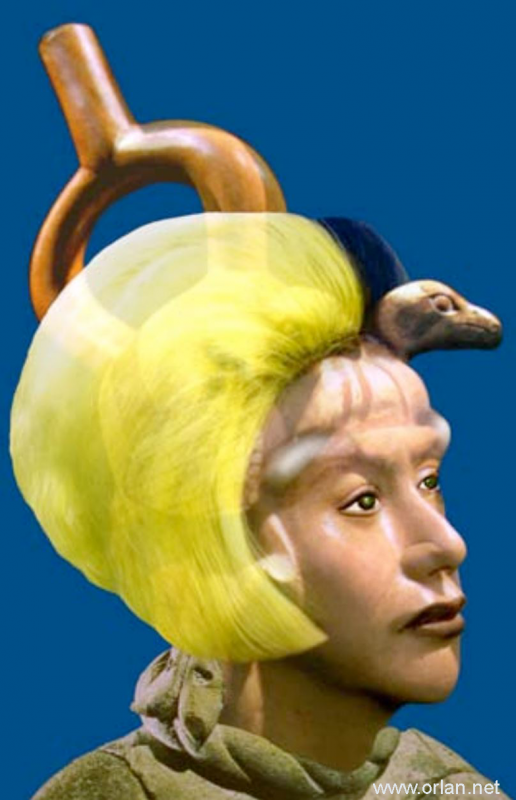
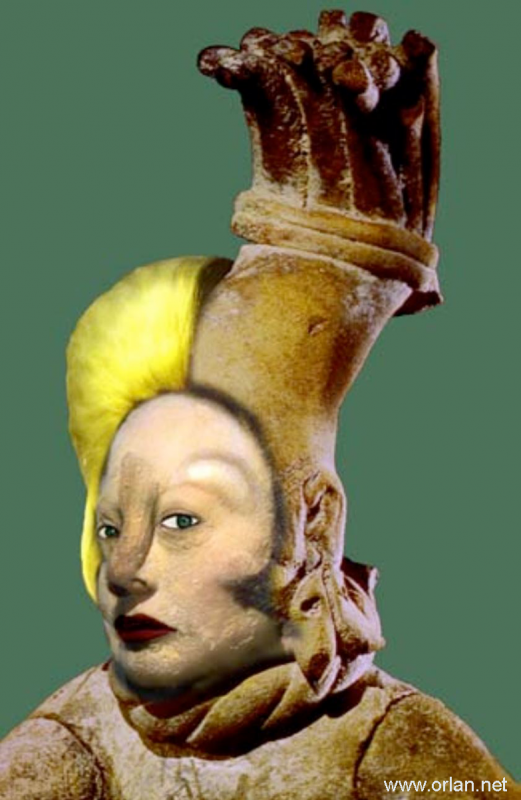
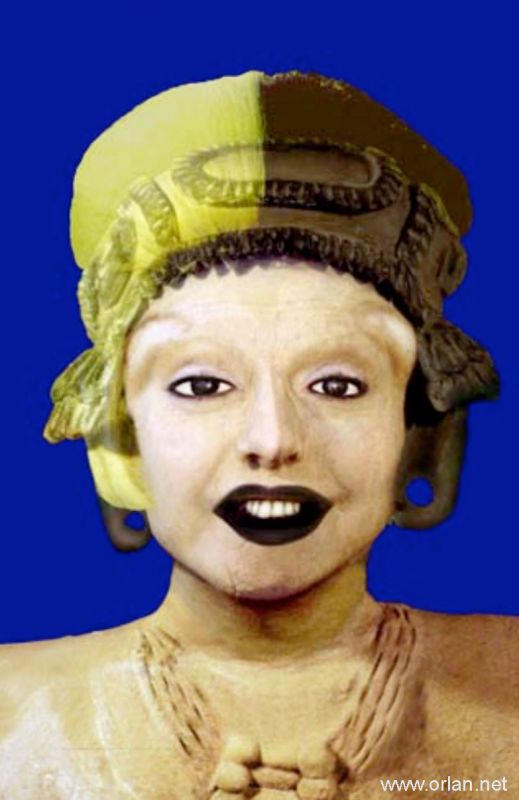
For Everlasting Peace (Wings), digital photomontage, 2024
This photomontage combines the ORLAN photo shoot taken in Mérida in 2022 with her statuette created by the RMN. It serves as the cover for the English edition of her autobiography.
no images were found
I allow you to be me, I allow myself to be you, digital photo montage, 2024
“I allow you to be me; I allow myself to be you” is a new series created by ORLAN as a continuation of her series on self-hybridization.
The artist creates self-hybridizations in homage to women in history whom she admires because they defended causes that ORLAN supports in her life and work. C he pioneering women who paved the way for other women took risks that sometimes cost them their lives. S oten forgotten, erased or under-represented, ORLAN brings them back into the limelight with this series. The artist, as usual, breaks down the ice walls between artistic practices, genres, eras and skin tones. C This act of blending with the other allows her, in a spirit of sisterhood, to bestow an artist’s kiss upon them and to bring women together despite the mists of time that separate them. E n reference to the great historical portraits, ORLAN prints these artists’ digital photomontages on canvas stretched and framed.
(Work in progess, other femmages are in production)
Endangered Animals and New Robots Made from Recycled Objects and Materials VERSION 2, digital photomontage created using artificial intelligence, 2024
ORLAN questions the social phenomena of our time. In this series, first created with artificial intelligence (a current social phenomenon), the artist reappropriates this tool by reworking the images provided, to take a stand on the disappearance of certain animal species caused by human activity, our waste, deforestation , global warming… It promotes a new generation of responsible technologies through robots made from recycled objects and materials. In these works, they rebuild what previous technologies have destroyed. This second wave of technology is no longer destructive, but benevolent towards the living world, and takes into account the chain reactions it can provoke in a world we want to preserve/protect. Through her new works, ORLAN hopes that innovation will be fair and responsible, and no longer anthropocentric.
no images were found
ORLAN X Abel Azcona, The Chosen Mothers, photographed by Lekuona, 2023
Abel Azcona, a promising newcomer to contemporary performance, invites ORLAN for a highly personal collaboration.
A Spanish artist who was orphaned—born to a mother who was a prostitute and heroin addict and who abandoned him at birth—he explores this void, this absence, in his work. Abel Azcona has created a new project in which he invites prominent women from the art world who have inspired him to participate in a series of duet photographs. They do not replace his mother but serve as guides—strong, empowering female role models. It is also a tribute to the mothers of performance art. Two generations come together: the historic artists and the new generation. Abel Azcona began this series in Amsterdam with Marina Abramović, and he is continuing it today in Paris with ORLAN.
The Elephant of the African forest is endangered, and new robots made from recycled objects and materials; digital photomontage, 2023
This work was created by ORLAN in 2023 as part of Équinoxes 9. Équinoxes is a dynamic collaboration between the Camille Fournet fashion house and an artist: an exchange of creative worlds, a space for artistic freedom without restraint, inspired by the house’s signature style.
For this event, ORLAN is creating “The Endangered African Forest Elephant and New Robots Made from Recycled Objects and Materials.” This work continues the artist’s exploration of endangered animals, with the unique twist that the elephant is a hybrid featuring the skin of a leopard and a lizard.
“Leather goods bring us back to the craftsmanship known as ‘la belle main,’ as well as to bags made of leather or animal hides (lizard, crocodile, etc.). Currently, we’re examining all the materials we use—whether natural or synthetic—as well as their carbon footprint. My work explores the disappearance of certain animals and birds. I depict these animals—which I hybridize with other animals—in their natural habitats, surrounded by robots. The robots are made from recycled materials. They are there to question new technologies that can either destroy or build a more responsible world.” ORLAN
Disfiguration-Refiguration, Maya Self-Hybridizations: ORLAN hybridized with anthropomorphic Maya figures, digital photomontage, 2022
Following a proposal by Leïla Voight, curator of the exhibition, Le Grand Musée du Monde Maya invited ORLAN to create works based on its collection of Mayan statuary. In this new series of 12 photographs, you can see Maya sculptures produced in durable materials, jade, stone… materials that can stand the test of time and therefore be seen from culture to culture, heritage to heritage.
In these photos, ORLAN has recreated the materials and textures used by these unknown artists, who inspired him in his creative process. These are mutating bodies emerging from the earth, stone, and jade; many are green, while others are red, symbolizing the importance of blood and the sun to the Maya. The yellow of corn, the brown of the earth, and the gray of stone are evident. There is a convergence of two forms of materiality—the tangible materials and the digital pixels that ORLAN employs and weaves into her works. The hybridization that most breaks free from Maya iconography is the one in jade: the anthropomorphic mask sticking out its tongue is the museum’s star attraction. ORLAN has inserted her eyes, tongue, and blue wig into it. The predominantly male Maya statuary has been feminized through ORLAN’s face, and each portrait depicts a different age.
ORLAN’s “The Dove” performance, photographed by Pim Schalkwijk in Mérida, 2022
no images were found
The Origin of War, lenticular print featuring Gustave Courbet’s *The Origin of the World *, digital photomontage, 2022
In 1989, ORLAN examined the work that, in her view, is the most monstrous in the history of art: Courbet ’s *The Origin of the World *.
In his painting of 1886, Courbet mutilates the woman, cutting off her legs, arms and head, stripping her of her identity by reducing her to the role of genitress. She becomes nothing more than a belly, more than a sex, probably as the commissioner intended.
ORLAN decided to see what would happen if she did the same thing to the other half of humanity by reproducing the work—including its dimensions and frame—in the form of a photograph. In it, she features Jean-Christophe Bouvet, an actor who starred in *Sous le soleil de Satan* alongside Gérard Depardieu, with his average-sized penis in an erect state. ORLAN describes it as “the devil’s penis.”
This feminist response questions the role of men and women in our society and how they are represented.
In 2022, in view of current events, ORLAN created a second version of “L’Origine de la guerre“, thirty years after the first, with a new model.
Endangered Animals and New Robots Made from Recycled Objects and Materials VERSION 1, digital photomontage, 2022
In 2022, ORLAN created a series of works to explore the phenomenon of endangered animals. The artist features: the jaguar, the white tiger, the polar bear, the blue peacock, the African forest elephant, the Sunda tiger, the golden eagle, the flamingo, the cobra, the lynx, the seahorse, the kangaroo, the giant panda, the water dragon, the orangutan, the penguin, the dolphin, the koala, and the cheetah… alongside robots. These animals are placed in their natural habitats. Through this series, ORLAN offers an eco-sensitive reflection and raises awareness of the Anthropocene.
These robots, made from recycled materials and bearing ORLAN’s face, can be interpreted in two ways: we can see them both as destroyers and symbols of a dreaded future, or as protectors, standing by the animals’ side and guiding the last survivors of their species toward a reimagined future. Robots and new technologies challenge our understanding of the connection between the animal and human kingdoms. Just as much as these species left to their inexorable extinction, these robots are rebus images of modernity—made from obsolete, abandoned, and discarded objects that ORLAN recycles to give them new value and create with humor.
Part of the series is materialized in the form of luminous tapestries printed on fiber optics, powered by an LED track system. They have been produced using technology developed by brochier® technologies.
Self-hybridization Among Women, digital photomontage, 2019–2020
Les Self-hybridations entre femmes is a series of photographs in which ORLAN hybridizes with Pablo Picasso’s portraits of Dora Maar crying. The series consists of two acts: “ORLAN s’hybride aux portraits des femmes de Picasso” and “Les Femmes qui pleurent sont en colère”.
ORLAN creates jarring digital collages into which she inserts fragments of her face: her bulging eyes, her crossed eyes, her upside-down ear, and her screaming mouth baring teeth ready to bite—all to express anger through her work. It is a snapshot of this moment of realization. ORLAN does not put Pablo Picasso or Dora Maar on trial—for they can no longer defend themselves—but speaks out on behalf of today’s women who remain in the shadows: the inspirers, the models, the muses who played a pivotal role in the fame of our great masters. It is a call to emancipation. ORLAN tells them, “Stop being objects; become subjects. Emancipate yourselves; stop enduring; stop crying.”
ORLAN & ORLANoïde, a bodiless mask over text generated by a robot, digital photomontage digital, 2018
no images were found
Petition Against Death, silkscreen print, 2018
no images were found
Literature Review: Drapery in the Baroque: Zoom Baroque / Folds and Unfolds, 2015
This series is part of the documentary study *Le Drapé-le Baroque*. From her earliest cross-dressing experiments using the sheets from her trousseau, ORLAN has been fascinated by folds and has explored the interplay of light and shadow. She has created two series of drapery studies—photographs of folds. ORLAN frames close-ups of drapery made from the linens of her trousseau, which very often take on organic forms, curves and counter-curves, vulvas…
no images were found
Self-Hybridizations: Beijing Opera Masks, Facing Designs, and Augmented Reality, Digital Photomontage, 2014
In 2014, ORLAN created a hybrid performance combining her work with the masks of the Beijing Opera, resulting in a series of Chinese “self-hybridizations.” In this opera, women are barred from performing, and men play their roles.
ORLAN had his body scanned and then articulated so that he could perform all the acrobatics of the Peking Opera. With an artificial body, all distortions are conceivable; with a biological body, they are impossible.
ORLAN has dressed her avatars and added tattoos that repeat the same motifs of hybridized photography. Each work of art has a different avatar, which comes out of the frame if you download the ARTI VIVE application and scan the work of art with it.
You can then take photos of yourself, your friends and your avatar, and send them around the world just like any other selfie.
Research Study: Drapé-le Baroque: Flowing Folds, 3D Photographs, Lenticular Print, 2012
ORLAN’s works featuring drapery seem to draw inspiration from the Winged Victory of Samothrace—which ORLAN saw at a very young age on the walls of her school—as well as from Bernini’s Baroque folds. For ORLAN, it is an extraordinary example of strength and dynamism. In 2012, the artist created a series titled *Plis Mouvants* (*Moving Folds*), in which she features computer-generated Baroque drapery, continuing the theme of her *Étude Documentaire* (*Documentary Study*). This series of 36 works was produced as lenticular prints, which create movement and cause the folds to shift depending on the viewer’s position. In these works, ORLAN incorporates organic references to the moving, twisting body and to female genitalia.
no images were found
Hybrid skin-like sheets—are you Belgian?, 2010
no images were found
When I Grow Up, I Want to Be an Art Collector, 2009
no images were found
I Am a Woman and a Man, 2009
no images were found
“Self-Hybridizations,” Portrait of ORLAN and Agatha Ruiz de la Prada, digital photomontage, 2007
Some collectors who wish to buy works of self-hybridization sometimes ask ORLAN to create hybridizations between the artist and themselves. ORLAN, for example, created a work with the face of her fashion designer friend Agatha Ruiz de la Prada in 2007.
no images were found
Apple-Butt and Little Flowers, digital photomontage, 2007
no images were found
Defiguration-Refiguration, Native American self-hybridization, digital photo montage, 2005-2008
ORLAN began her third series exploring non-Western models in 2005, inspired by George Catlin’s paintings discovered during her residency in New York at the ISCP (International Studio and Curatorial Program) during a visit to the Smithsonian Museum. ORLAN was immediately drawn to the figure of George Catlin, who went to Native American tribes to paint tribal chiefs, staking his fortune on it.
In his travel diaries, he paints the natives with respect, at a time when everyone considered them dirty, uncultured savages. He painted them in all their magnificence, in their ceremonial clothes, with their jewels and their superb feathers. ORLAN based her Self-hybridations amérindiennes series on these paintings and drawings. Of course, she transgressed their laws, as it was impossible for a woman to be a leader. ORLAN represents herself with jewelry forbidden to women, in particular that made from bear claws.
African Self-Hybridizations, digital photomontage, 2000–2003
A year after her first series of Pre-Columbian Self-hybridations, ORLAN continues her reflection on non-Western beauty standards with the creation of the African Self-hybridations series, in memory of all the exciting study trips to Africa that so marked her youth.
This series consists of a series of black and white photographs based on ethnographic photography, the first photos in which the Other is photographed. ORLAN also creates a few color works, as well as resin sculptures of mutant characters, notably exhibited at the 1999 Lyon Biennial of Contemporary Art: “Partage d’exotismes”, curated by Jean-Hubert Martin.
In her series, ORLAN creates a manifesto work “Femme Surmas avec Labret et Visage de Femme Euro-Stéphanoise avec bigoudis” (Surmas Woman with Labret and Euro-Stephanoise Woman’s Face with Curlers), which demonstrates that beauty is merely a question of dominant ideology in a historical and geographical location.
ORLAN presents a woman with a huge labret, very confident and sure of her ability to seduce, because in her tribe, the bigger the labret, the more desirable the woman. If we wore a labret here and now, in our Western culture, we would be designated by all as unbeatable monsters!
African Self-Hybridizations, digital color photomontage, 2000–2003
A year after her first series of Pre-Columbian Self-hybridations, ORLAN continues her reflection on non-Western beauty standards with the creation of the African Self-hybridations series, in memory of all the exciting study trips to Africa that so marked her youth.
This series consists of a collection of black-and-white photographs based on ethnographic images—the earliest photographs in which people began to photograph “the Other.” ORLAN also created several color works as well as resin sculptures of mutant figures, which were notably exhibited at the 1999 Lyon Biennale of Contemporary Art: “Partage d’exotismes,” curated by Jean-Hubert Martin.
In her series, ORLAN creates a manifesto work “Femme Surmas avec Labret et Visage de Femme Euro-Stéphanoise avec bigoudis” (Surmas Woman with Labret and Euro-Stephanoise Woman’s Face with Curlers), which demonstrates that beauty is merely a question of dominant ideology in a historical and geographical location.
ORLAN presents a woman with a huge labret, very confident and sure of her ability to seduce, because in her tribe, the bigger the labret, the more desirable the woman. If we wore a labret here and now, in our Western culture, we would be designated by all as unbeatable monsters!
In 1989 and 1992, ORLAN received two grants from FIACRE and the Fonds d’Innovation Artistique et Culturel en Rhône-Alpes, to take up a residency in Chennai (then called Madras), India. For her second three-and-a-half-month trip, she was accompanied by Stephan Oriach, a director with whom ORLAN had collaborated in the past.
His trip to India was part of “le plan du film”, a series of works imagined from the reading of a quote by Jean-Luc Godard: “The only greatness of Jacques Becker’s Montparnasse 19 is that it is not only an upside-down film, but in a way the upside-down of cinema.” The concept was to take Godard literally, to create an upside-down film, starting with the poster and promotion with the trailer, letrilles, a soundtrack and a TV show to launch the feature. ORLAN enlisted the help of Publidécor, an advertising agency specializing in 1950s painted movie posters, to create fourteen painted posters based on photos of the artist and recycled works. Her intention with these hand-painted acrylic posters on 3 m x 2 m canvases was to tell the story of her life in art. ORLAN made the posters using the names of her friends in the art world at the time, and one or two names of movie stars to make it seem as if the film existed. She also staged a fake press conference with director Bigas Luna and curator Lorand Hegyi for a Valencia biennial. She invited a number of journalists to talk about a film she had made that didn’t really exist.
In 1998, ORLAN decided to travel to Mexico in the footsteps of Antonin Artaud. After her study trips, and in particular her encounter with the team at Mexico City’s Museum of Anthropology, ORLAN began her post-operation series Défiguration-Refiguration, Self-hybridation, using her new image to make new images.
For her first series, the artist hybridizes with pre-Columbian cultures, with over thirty works, some inspired by the skull deformations found among pre-Columbians, Africans, Egyptians and Merovingians! The Vierge à l’Enfant (Virgin and Child) from Rabastens attests to this, showing both the Virgin and Child with a deformed, elongated skull.
In her work, ORLAN has sought to break away from Western references and stereotypes of beauty, creating this first series using digital photography and interactive 3D video installations based on skull deformities, squinting, nose jobs known to the Mayas, Olmecs and Aztecs, and representations of the god Xipe Totec.
Inspired by Lars Von Trier’s film “The Idiots” and its critique of conformist behavior, ORLAN presents herself in this highly humorous series. In some photos, she’s dressed as the perfect housewife, posing in front of the camera in curlers and cleaning gloves, alternately stroking phallic vegetables or serving tea, with the caption “Vous prendsz bien un peu de contenu… Monsieur Greenberg”.
On others she poses with one or more multicolored ballets in dynamic gestures, and in the last she stages herself with post-operative bandages and false blues.
The installation of the work, inspired by Thomas McEvilley’s Art and Discontent-Theory at the Millenium, features a motion detector that triggers a recording of ORLAN repeating the phrase “Would you care for some content, Mr. Greenberg?”.
In 1997, ORLAN wanted to work with the forensic police on DNA sequencing, which had just been used to solve criminal cases.
The “Exogène” exhibition, created by Bruno Guiganti and Morten Salling, took the form of a multi-part criminal investigation and identity quest. Works created by ORLAN using her own blood and flesh have been submitted to the Danish forensic police for sequencing to verify whether they were created by the same artist. Sequencing analysis proved that they had indeed been produced by ORLAN. These works were a reliquary with flesh in the center and a St suaires soaked in ORLAN’s blood.
This fiction within a fiction spread throughout Copenhagen. Wanted posters featuring ORLAN were then put up all over the city, and a skull supposedly found by the art center was handed over to the criminal investigation department to find out if it might belong to her.
Traces of this investigation (works by ORLAN, fingerprints, DNA sequencing, wanted notices, skulls, etc.) were then exhibited in the desecrated Nikolaj Church, transformed into an art center.
ORLAN’s Hybridization with the Mona Lisa, 1994–1999
no images were found
Self-Hybridation, In-Between, 1993–1994
In 1994, ORLAN presented the Entre-deux images created for the Omniprésence 2 installation in 1993 in the form of light boxes. These images represent ORLAN’s face, created using morphing software.
ORLAN has captured the “in-between”, i.e. the exact image of the environment conceived from her face hybridized with a portrait of one of her art-historical reference figures, without retouching.
no images were found
Seduction vs. Seduction, Photographic Triptych, 1993
On May 30, 1990, in a desecrated church called “All Saints” in Newcastle, England, ORLAN announced her decision to undertake Opérations-Chirurgicales-Performances in an inaugural performance-ritual, reading from her manifesto of Charnel Art, which she had written in 1989.
THE REINCARNATION OF SAINT ORLAN OR NEW IMAGES-IMAGES Thereincarnation of Saint ORLAN (alluding to the character who had gradually created herself by adopting religious images in her great series) Literature Review: Drapery, Baroque) or “new images” (a nod to the Hindu gods and goddesses who change their appearance to undertake new tasks and achieve new feats). For ORLAN, this involves shifting her frame of reference, moving from Judeo-Christian religious iconography to Greek mythology. Furthermore, this second title alludes to the so-called “new images”—that is, new technologies—known as “surgical-performance operations,” a series of nine performances carried out by ORLAN between 1990 and 1993 in Paris, Brussels, and New York. ORLAN created this series to subvert surgery’s conventional focus on enhancement and rejuvenation and to perform surgical procedures that were not intended to produce beauty but rather ugliness, monstrosity, and undesirability.
The central idea behind these surgical operations was to combat stereotypes and models. ORLAN is not against cosmetic surgery, but against what we do with it. She uses this technique to invent the self-love by attacking the mask of the innate. The first condition with the different surgeons was no pain, because ORLAN is all for BODY-PLEASURE. For each performance, ORLAN decorated the operating theatre, turning it into her artist’s studio. She and the rest of the medical staff were costumed by a renowned designer working in collaboration with the artist. The performances were orchestrated by readings, and when the surgical gesture allowed it, ORLAN produced images, films, videos, photos, drawings with her blood and fingers, reliquaries with her fat and flesh, “holy-suaries” of sorts made with her dried blood and medical gauze from the operation onto which she made photographic transfers, and objects subsequently exhibited in museums and galleries.
In 1993, ORLAN created a series of 10 triptychs based on images from Opérations-Chirurgicales-Performances. ORLAN made screenshots of the videos of the operations, which she mirrored and framed. In the middle, she inserted an unframed black-and-white photo with bandages after the operations. The idea was to draw a parallel between the idea of seduction and counter-seduction in photography. There was the photographic seduction of color, frame and the grandeur of the two mirrored screenshots, as opposed to the colorless, frameless photograph in the middle.
no images were found
The Reincarnation of Sainte-ORLAN, or New Images-Images / 9th Surgical Performance, December 14 , 1993
In June 1989, some British curators who had seen ORLAN’s performances at the Centre Pompidou during an event centered on Fluxus and Happenings invited her to participate in their Edge festival (May 22–30, 1990) by creating a work on the theme “Art and Life in the 1990s.”
One could say, then, that this is a commissioned performance. In this proposal, she found a way to speak out loud and clear about how negatively she viewed artistic production in the 1980s. She therefore decided to stage a performance that went against the grain, serving as a counterpoint to what was happening in the contemporary art scene. In those years, most artists had become completely conformist and overly accommodating to market forces. ORLAN wanted to create a performance that built on her previous work—one that looked toward the future, radical in and of itself and transcending her own persona.
It was while reading *La Robe* (which she would use as a motto for all her surgical-performance operations) by Eugénie Lemoine-Luccioni, a Lacanian psychoanalyst, that the idea of this “passage à l’acte” occurred to her. She thought that at that time they were beginning to have the means to bridge the gap between the internal image and the external image. She then said that she was engaging in “woman-to-woman transsexualism,” alluding to transsexuals: a man who feels like a woman wants others to see him as a woman (and vice versa). We could summarize this by saying that it is a communication problem. ORLAN creates a classic self-portrait, initially developed using a computer and then permanently inscribed on her flesh. She refers to this as “carnal art” to distinguish it from body art and questions the status of the body in society and its future in coming generations through new technologies and genetic manipulation.
The artist’s body becomes a venue for public debate.
On May 30, 1990, ORLAN’s birthday, in a deconsecrated church called “All Saints” in Newcastle, England, she announced, during an inaugural ritual performance, her decision to undertake the Surgical-Performance Operations by reading her “Carnal Art” manifesto, which she had written in 1989.
The series has two titles: TheThe Reincarnation of Sainte-ORLAN (a reference to the character who gradually came into being by adopting religious imagery in her major series Documentary Study: The Drapery, The Baroque) or new images—images (A nod to the Hindu gods and goddesses who change their appearance to undertake new works and achieve new feats. For ORLAN, this involves shifting her frame of reference—moving from Judeo-Christian religious iconography to Greek mythology. Furthermore, this second title alludes to the so-called “new images,” that is, new technologies.) It is a series of nine performances created by ORLAN between 1990 and 1993 in Paris, Brussels, and New York.
In the very beginning, ORLAN created a self-portrait by mixing and blending, using a computer, images of goddesses from Greek mythology—chosen not for the beauty standards they are supposed to represent, but rather for their stories.
Diane was chosen because she defies both gods and men, because she is proactive—even aggressive—and because she leads a group. The Mona Lisa as a flagship figure in art history, as a point of reference, because she isn’t beautiful by today’s standards of beauty, because there is a man hidden beneath this woman. We now know that it is Leonardo da Vinci’s self-portrait that lies hidden beneath the Mona Lisa (which brings us back to the issue of identity).
ORLAN will say:
“ So I don’t want to look like Botticelli’s Venus.
I don’t want to look like Gustave Moreau’s Europa (who isn’t my favorite painter). I chose this painter’s depiction of Europa because she appears in an unfinished painting—as, in fact, do most of his paintings!
I don’t want to look like Gérard’s Psyche.
I don’t want to look like Diane from the Fontainebleau School.
I don’t want to look like Leonardo da Vinci’s Mona Lisa… as some newspapers and television shows have said and continue to say, despite my many contradictions and outbursts of anger. (The media coverage I can’t escape—whether in print or on television—will be analyzed and make sense in about ten years.) ”
For ORLAN, these depictions of female figures serve as a framework and a source of inspiration, and are symbolically far below them. Through this process of digital hybridization, she asked the surgeons to come as close as possible to this image.
In the three most recent surgical procedures performed in New York, ORLAN has broken free from conventional models by carrying out operations that were not intended to create beauty but rather ugliness and monstrosity.
At first, finding a surgeon was difficult. After many rejections, ORLAN found one—a very cautious surgeon who started by taking small steps, which allowed her to understand what she was getting into and to assess what she could manage to do in an operating room, what the limitations were and her own limits, understand how she reacted, how her body reacted, and thus learn to manage the entire surgical process better and better.
ORLAN created this series to disrupt the conventional practices of cosmetic surgery aimed at enhancement and rejuvenation. ORLAN is not against cosmetic surgery itself, but rather against the way it is used. She thus uses this technique to create a form of self-love by challenging the mask of the “natural.” The primary condition agreed upon with the various surgeons was that there be no pain, as ORLAN advocates for BODY-PLEASURE.
Each procedure was conceived as a rite of passage. As a visual artist, ORLAN sought to challenge the cold, stereotypical aesthetics of surgery and transform them. For each performance, ORLAN decorated the operating room, which, through this act, became her artist’s studio. She and the entire medical staff were dressed by a renowned designer who collaborated with the artist. The performances were punctuated by readings, and whenever the surgical procedure allowed, ORLAN created images, made films, videos, photographs, and drawings using her blood and fingers, reliquaries with her fat and flesh, a sort of “holy shroud” made from her dried blood and medical gauze from the surgery—onto which she made photographic transfers—and objects that were subsequently exhibited in museums and galleries.
The 9th Surgical Performance took place on December 14, 1993, in New York in collaboration with the Sandra Gering Gallery.
During this procedure, ORLAN was operated on by feminist surgeon Dr. Marjorie Kramer, who inserted the largest implants possible for ORLAN’s anatomy. Only one was rejected by ORLAN’s body, and the outfit was designed by Lan Vu and her team.
The photographers were Robert Puglisi and Vladimir Sichov for Pipa-Press.
ORLAN then decorates the operating room with a bright yellow fabric that matches the surgeon’s scrubs.
no images were found
OMNIPRESENCE II
New York, Galerie Sandra Gering, 1993
OMNIPRÉSENCE II is the major component in surgical-performance operations.
This is a photographic installation presented as a work in progress in the Sandra Gering gallery , based on two ideas: to show what is usually kept secret, and to establish a comparison between the self-portrait made by the machine-computer and the self-portrait made by the MACHINE-CORPS. For this purpose, ORLAN had arranged 40 metal diptychs lacquered red-brown like dried blood in the gallery, corresponding to 40 days of exhibition. At the bottom of the diptych: a screen shot showing the image of a face created using morphing software.
ORLAN has captured the “in-between”, i.e. the exact image of the environment conceived from her face hybridized with a portrait of one of her art-historical reference figures, without retouching.
At the top, on the other side of the diptych, ORLAN used magnets to place the image of the day, a self-portrait made by the MACHINE-CORPS, of a face first with bandages, then with colors: from blue to yellow to red, the whole quite swollen. A metal plate was installed between these two images, engraved with the words: entre-deux and the day’s date.
By the last day, the installation was complete and so was the exhibition.
The Reincarnation of Sainte-ORLAN, or New Images-Images / 7thSurgical Performance, titled “Omnipresence,” November 21, 1993
In June 1989, some British curators who had seen ORLAN’s performances at the Centre Pompidou during an event centered on Fluxus and Happenings invited her to participate in their Edge festival (May 22–30, 1990) by creating a work on the theme “Art and Life in the 1990s.”
One could say, then, that this is a commissioned performance. In this proposal, she found a way to speak out loud and clear about how negatively she viewed artistic production in the 1980s. She therefore decided to stage a performance that went against the grain, serving as a counterpoint to what was happening in the contemporary art scene. In those years, most artists had become completely conformist and overly accommodating to market forces. ORLAN wanted to create a performance that built on her previous work—one that looked toward the future, radical in and of itself and transcending her own persona.
It was while reading *La Robe* (which she would use as a motto for all her surgical-performance operations) by Eugénie Lemoine-Luccioni, a Lacanian psychoanalyst, that the idea of this “passage à l’acte” occurred to her. She thought that at that time they were beginning to have the means to bridge the gap between the internal image and the external image. She then said that she was engaging in “woman-to-woman transsexualism,” alluding to transsexuals: a man who feels like a woman wants others to see him as a woman (and vice versa). We could summarize this by saying that it is a communication problem. ORLAN creates a classic self-portrait, initially developed using a computer and then permanently inscribed on her flesh. She refers to this as “carnal art” to distinguish it from body art and questions the status of the body in society and its future in coming generations through new technologies and genetic manipulation.
The artist’s body becomes a venue for public debate.
On May 30, 1990, ORLAN’s birthday, in a deconsecrated church called “All Saints” in Newcastle, England, she announced, during an inaugural ritual performance, her decision to undertake the Surgical-Performance Operations by reading her “Carnal Art” manifesto, which she had written in 1989.
The series has two titles: TheThe Reincarnation of Sainte-ORLAN (a reference to the character who gradually came into being by adopting religious imagery in her major series Documentary Study: The Drapery, The Baroque) or new images—images (A nod to the Hindu gods and goddesses who change their appearance to undertake new works and achieve new feats. For ORLAN, this involves shifting her frame of reference—moving from Judeo-Christian religious iconography to Greek mythology. Furthermore, this second title alludes to the so-called “new images,” that is, new technologies.) It is a series of nine performances created by ORLAN between 1990 and 1993 in Paris, Brussels, and New York.
In the very beginning, ORLAN created a self-portrait by mixing and blending, using a computer, images of goddesses from Greek mythology—chosen not for the beauty standards they are supposed to represent, but rather for their stories.
Diane was chosen because she defies both gods and men, because she is proactive—even aggressive—and because she leads a group. The Mona Lisa as a flagship figure in art history, as a point of reference, because she isn’t beautiful by today’s standards of beauty, because there is a man hidden beneath this woman. We now know that it is Leonardo da Vinci’s self-portrait that lies hidden beneath the Mona Lisa (which brings us back to the issue of identity).
ORLAN will say:
“ So I don’t want to look like Botticelli’s Venus.
I don’t want to look like Gustave Moreau’s Europa (who isn’t my favorite painter). I chose this painter’s depiction of Europa because she appears in an unfinished painting—as, in fact, do most of his paintings!
I don’t want to look like Gérard’s Psyche.
I don’t want to look like Diane from the Fontainebleau School.
I don’t want to look like Leonardo da Vinci’s Mona Lisa… as some newspapers and television shows have said and continue to say, despite my many contradictions and outbursts of anger. (The media coverage I can’t escape—whether in print or on television—will be analyzed and make sense in about ten years.) ”
For ORLAN, these depictions of female figures serve as a framework and a source of inspiration, and are symbolically far below them. Through this process of digital hybridization, she asked the surgeons to come as close as possible to this image.
In the three most recent surgical procedures performed in New York, ORLAN has broken free from conventional models by carrying out operations that were not intended to create beauty but rather ugliness and monstrosity.
At first, finding a surgeon was difficult. After many rejections, ORLAN found one—a very cautious surgeon who started by taking small steps, which allowed her to understand what she was getting into and to assess what she could manage to do in an operating room, what the limitations were and her own limits, understand how she reacted, how her body reacted, and thus learn to manage the entire surgical process better and better.
ORLAN created this series to disrupt the conventional practices of cosmetic surgery aimed at enhancement and rejuvenation. ORLAN is not against cosmetic surgery itself, but rather against the way it is used. She thus uses this technique to create a form of self-love by challenging the mask of the “natural.” The primary condition agreed upon with the various surgeons was that there be no pain, as ORLAN advocates for BODY-PLEASURE.
Each procedure was conceived as a rite of passage. As a visual artist, ORLAN sought to challenge the cold, stereotypical aesthetics of surgery and transform them. For each performance, ORLAN decorated the operating room, which, through this act, became her artist’s studio. She and the entire medical staff were dressed by a renowned designer who collaborated with the artist. The performances were punctuated by readings, and whenever the surgical procedure allowed, ORLAN created images, made films, videos, photographs, and drawings using her blood and fingers, reliquaries with her fat and flesh, a sort of “holy shroud” made from her dried blood and medical gauze from the surgery—onto which she made photographic transfers—and objects that were subsequently exhibited in museums and galleries.
The 7th surgical operation-performance, known as Omniprésence, took place on November 21 1993 in New York in collaboration with the Sandra Gering Gallery.
During this procedure, ORLAN was operated on by feminist surgeon Dr. Marjorie Kramer and dressed by Issey Miyake. The photographers were Robert Puglisi and Vladimir Sichov for Sipa-Press (the photos are royalty-free).
ORLAN decorates the operating room with a neon green fabric that matches the surgeon’s scrubs.
Among the medical team and the STUDIO ORLAN team was a woman who specialized in sign language for the deaf and hard-of-hearing, and her presence served as a reminder that we are all, at certain times, deaf or hard-of-hearing. Her presence in the operating room highlighted the importance of body language.
There was also Raphaël Cuir as an assistant, videographer Tom Klinkowstein, who handled the satellite transmission, Sophie Thompson handled the English translation, and the famous star news anchor of the time, Connie Chung, who had asked to be in the operating room with ORLAN and produced a full report that aired on CNN’s 8 p.m. evening news. She came to France to attend ORLAN’s wedding to Raphaël Cuir in Sologne.
During this mythical operation, ORLAN had solid silicone implants placed on her cheekbones to enhance them on both sides of her forehead. The idea was to create an operation that wouldn’t bring beauty but, on the contrary, undesirability and monstrosity. ORLAN wanted to demonstrate that beauty is a dictate of the dominant ideology in a geographical and historical point in time. These bumps have become organs of seduction. ORLAN says “it’s my convertible”.
This performance was broadcast live via satellite thanks to Christian Vanderborght at the Centre Georges Pompidou in Paris, the MacLuhan Centre in Toronto, the Banff Centre for the Arts in Canada, in Belgium, Germany, Latvia, Japan, the Netherlands, New York, Santa Monica, and in France in Nice and Lyon. Clocks adorned the stage and displayed the time in the various cities where the performance was being broadcast.
Spectators from all over the world were able to watch the operation and ask questions, which ORLAN answered live as soon as the surgical procedure allowed. Participants in the satellite transmission at the Centre Georges Pompidou included Gladys Fabre, Jean-Paul Fargier, Christian Vanderborght and François Barré, President of the Centre, among others.
ORLAN played with notions of vanity and narcissism in the 1993 series Question de miroir. Taken before Omniprésence, the artist stages herself against a green background, as she would later do in the operating theater. In these images, we see ORLAN and/or her reflection in a hand mirror showing the result of a make-up session. Instead of using cosmetics to beautify herself, she covers her face with a flesh-colored substance resembling viscous modeling clay, alternately disfiguring and refiguring herself.
no images were found
The Reincarnation of Sainte-ORLAN, or New Images—Images / 6th Surgical Performance, February 1992
In June 1989, some British curators who had seen ORLAN’s performances at the Centre Pompidou during an event centered on Fluxus and Happenings invited her to participate in their Edge festival (May 22–30, 1990) by creating a work on the theme “Art and Life in the 1990s.”
One could say, then, that this is a commissioned performance. In this proposal, she found a way to speak out loud and clear about how negatively she viewed artistic production in the 1980s. She therefore decided to stage a performance that went against the grain, serving as a counterpoint to what was happening in the contemporary art scene. In those years, most artists had become completely conformist and overly accommodating to market forces. ORLAN wanted to create a performance that built on her previous work—one that looked toward the future, radical in and of itself and transcending her own persona.
It was while reading *La Robe* (which she would use as a motto for all her surgical-performance operations) by Eugénie Lemoine-Luccioni, a Lacanian psychoanalyst, that the idea of this “passage à l’acte” occurred to her. She thought that at that time they were beginning to have the means to bridge the gap between the internal image and the external image. She then said that she was engaging in “woman-to-woman transsexualism,” alluding to transsexuals: a man who feels like a woman wants others to see him as a woman (and vice versa). We could summarize this by saying that it is a communication problem. ORLAN creates a classic self-portrait, initially developed using a computer and then permanently inscribed on her flesh. She refers to this as “carnal art” to distinguish it from body art and questions the status of the body in society and its future in coming generations through new technologies and genetic manipulation.
The artist’s body becomes a venue for public debate.
On May 30, 1990, ORLAN’s birthday, in a deconsecrated church called “All Saints” in Newcastle, England, she announced, during an inaugural ritual performance, her decision to undertake the Surgical-Performance Operations by reading her “Carnal Art” manifesto, which she had written in 1989.
The series has two titles: TheThe Reincarnation of Sainte-ORLAN (a reference to the character who gradually came into being by adopting religious imagery in her major series Documentary Study: The Drapery, The Baroque) or new images—images (A nod to the Hindu gods and goddesses who change their appearance to undertake new works and achieve new feats. For ORLAN, this involves shifting her frame of reference—moving from Judeo-Christian religious iconography to Greek mythology. Furthermore, this second title alludes to the so-called “new images,” that is, new technologies.) It is a series of nine performances created by ORLAN between 1990 and 1993 in Paris, Brussels, and New York.
In the very beginning, ORLAN created a self-portrait by mixing and blending, using a computer, images of goddesses from Greek mythology—chosen not for the beauty standards they are supposed to represent, but rather for their stories.
Diane was chosen because she defies both gods and men, because she is proactive—even aggressive—and because she leads a group. The Mona Lisa as a flagship figure in art history, as a point of reference, because she isn’t beautiful by today’s standards of beauty, because there is a man hidden beneath this woman. We now know that it is Leonardo da Vinci’s self-portrait that lies hidden beneath the Mona Lisa (which brings us back to the issue of identity).
ORLAN will say:
“ So I don’t want to look like Botticelli’s Venus.
I don’t want to look like Gustave Moreau’s Europa (who isn’t my favorite painter). I chose this painter’s depiction of Europa because she appears in an unfinished painting—as, in fact, do most of his paintings!
I don’t want to look like Gérard’s Psyche.
I don’t want to look like Diane from the Fontainebleau School.
I don’t want to look like Leonardo da Vinci’s Mona Lisa… as some newspapers and television shows have said and continue to say, despite my many contradictions and outbursts of anger. (The media coverage I can’t escape—whether in print or on television—will be analyzed and make sense in about ten years.) ”
For ORLAN, these depictions of female figures serve as a framework and a source of inspiration, and are symbolically far below them. Through this process of digital hybridization, she asked the surgeons to come as close as possible to this image.
In the three most recent surgical procedures performed in New York, ORLAN has broken free from conventional models by carrying out operations that were not intended to create beauty but rather ugliness and monstrosity.
At first, finding a surgeon was difficult. After many rejections, ORLAN found one—a very cautious surgeon who started by taking small steps, which allowed her to understand what she was getting into and to assess what she could manage to do in an operating room, what the limitations were and her own limits, understand how she reacted, how her body reacted, and thus learn to manage the entire surgical process better and better.
ORLAN created this series to disrupt the conventional practices of cosmetic surgery aimed at enhancement and rejuvenation. ORLAN is not against cosmetic surgery itself, but rather against the way it is used. She thus uses this technique to create a form of self-love by challenging the mask of the “natural.” The primary condition agreed upon with the various surgeons was that there be no pain, as ORLAN advocates for BODY-PLEASURE.
Each procedure was conceived as a rite of passage. As a visual artist, ORLAN sought to challenge the cold, stereotypical aesthetics of surgery and transform them. For each performance, ORLAN decorated the operating room, which, through this act, became her artist’s studio. She and the entire medical staff were dressed by a renowned designer who collaborated with the artist. The performances were punctuated by readings, and whenever the surgical procedure allowed, ORLAN created images, made films, videos, photographs, and drawings using her blood and fingers, reliquaries with her fat and flesh, a sort of “holy shroud” made from her dried blood and medical gauze from the surgery—onto which she made photographic transfers—and objects that were subsequently exhibited in museums and galleries.
The sixth surgical performance took place in February 1992 as part of a performance festival in Liège, and takes its title Body Without Organs to Antonin Artaud. Artaud’s text is recited, while three skulls lend a more somber tone to the setting of this living “vanity.” ORLAN wears a faux leopard-print fur hat and plays with her plastic props (skulls, a cross, and a pitchfork). The surgeon performs liposuction on the face and abdomen.
no images were found
The Reincarnation of Sainte-ORLAN, or New Images-Images / 5th Surgical Performance, known as “Opération Opéra,” July 6, 1991
In June 1989, some British curators who had seen ORLAN’s performances at the Centre Pompidou during an event centered on Fluxus and Happenings invited her to participate in their Edge festival (May 22–30, 1990) by creating a work on the theme “Art and Life in the 1990s.”
One could say, then, that this is a commissioned performance. In this proposal, she found a way to speak out loud and clear about how negatively she viewed artistic production in the 1980s. She therefore decided to stage a performance that went against the grain, serving as a counterpoint to what was happening in the contemporary art scene. In those years, most artists had become completely conformist and overly accommodating to market forces. ORLAN wanted to create a performance that built on her previous work—one that looked toward the future, radical in and of itself and transcending her own persona.
It was while reading *La Robe* (which she would use as a motto for all her surgical-performance operations) by Eugénie Lemoine-Luccioni, a Lacanian psychoanalyst, that the idea of this “passage à l’acte” occurred to her. She thought that at that time they were beginning to have the means to bridge the gap between the internal image and the external image. She then said that she was engaging in “woman-to-woman transsexualism,” alluding to transsexuals: a man who feels like a woman wants others to see him as a woman (and vice versa). We could summarize this by saying that it is a communication problem. ORLAN creates a classic self-portrait, initially developed using a computer and then permanently inscribed on her flesh. She refers to this as “carnal art” to distinguish it from body art and questions the status of the body in society and its future in coming generations through new technologies and genetic manipulation.
The artist’s body becomes a venue for public debate.
On May 30, 1990, ORLAN’s birthday, in a deconsecrated church called “All Saints” in Newcastle, England, she announced, during an inaugural ritual performance, her decision to undertake the Surgical-Performance Operations by reading her “Carnal Art” manifesto, which she had written in 1989.
The series has two titles: TheThe Reincarnation of Sainte-ORLAN (a reference to the character who gradually came into being by adopting religious imagery in her major series Documentary Study: The Drapery, The Baroque) or new images—images (A nod to the Hindu gods and goddesses who change their appearance to undertake new works and achieve new feats. For ORLAN, this involves shifting her frame of reference—moving from Judeo-Christian religious iconography to Greek mythology. Furthermore, this second title alludes to the so-called “new images,” that is, new technologies.) It is a series of nine performances created by ORLAN between 1990 and 1993 in Paris, Brussels, and New York.
In the very beginning, ORLAN created a self-portrait by mixing and blending, using a computer, images of goddesses from Greek mythology—chosen not for the beauty standards they are supposed to represent, but rather for their stories.
Diane was chosen because she defies both gods and men, because she is proactive—even aggressive—and because she leads a group. The Mona Lisa as a flagship figure in art history, as a point of reference, because she isn’t beautiful by today’s standards of beauty, because there is a man hidden beneath this woman. We now know that it is Leonardo da Vinci’s self-portrait that lies hidden beneath the Mona Lisa (which brings us back to the issue of identity).
ORLAN will say:
“So I don’t want to look like Botticelli’s Venus.
I don’t want to look like Gustave Moreau’s Europa (who isn’t my favorite painter). I chose this painter’s depiction of Europa because she appears in an unfinished painting—as, in fact, do most of his paintings!
I don’t want to look like Gérard’s Psyche.
I don’t want to look like Diane from the Fontainebleau School.
I don’t want to look like Leonardo da Vinci’s Mona Lisa… as some newspapers and television shows have said and continue to say, despite my many contradictions and outbursts of anger. (The media coverage I can’t escape—whether in print or on television—will be analyzed and make sense in about ten years.) ”
For ORLAN, these depictions of female figures serve as a framework and a source of inspiration, and are symbolically far below them. Through this process of digital hybridization, she asked the surgeons to come as close as possible to this image.
In the three most recent surgical procedures performed in New York, ORLAN has broken free from conventional models by carrying out operations that were not intended to create beauty but rather ugliness and monstrosity.
At first, finding a surgeon was difficult. After many rejections, ORLAN found one—a very cautious surgeon who started by taking small steps, which allowed her to understand what she was getting into and to assess what she could manage to do in an operating room, what the limitations were and her own limits, understand how she reacted, how her body reacted, and thus learn to manage the entire surgical process better and better.
ORLAN created this series to disrupt the conventional practices of cosmetic surgery aimed at enhancement and rejuvenation. ORLAN is not against cosmetic surgery itself, but rather against the way it is used. She thus uses this technique to create a form of self-love by challenging the mask of the “natural.” The primary condition agreed upon with the various surgeons was that there be no pain, as ORLAN advocates for BODY-PLEASURE.
Each procedure was conceived as a rite of passage. As a visual artist, ORLAN sought to challenge the cold, stereotypical aesthetics of surgery and transform them. For each performance, ORLAN decorated the operating room, which, through this act, became her artist’s studio. She and the entire medical staff were dressed by a renowned designer who collaborated with the artist. The performances were punctuated by readings, and whenever the surgical procedure allowed, ORLAN created images, made films, videos, photographs, and drawings using her blood and fingers, reliquaries with her fat and flesh, a sort of “holy shroud” made from her dried blood and medical gauze from the surgery—onto which she made photographic transfers—and objects that were subsequently exhibited in museums and galleries.
The 5th operation-surgical-performance, known as Operation-Opera, took place on July 06, 1991 in Paris.
During this operation, ORLAN was operated on by Dr. Bernard Cornette de Saint-Cyr and dressed by fashion designer Franck Sorbier.
ORLAN complements the reading of *La Robe* with an excerpt from Michel Serres’ book *Le Tiers instruit*, engraved twenty times, in twenty different languages, on glass plates to which are attached containers holding twenty-gram portions of Orlan’s flesh: “The running monster—tattooed, ambidextrous, hermaphroditic, and mixed-race—what might it show us now, beneath its skin? Yes, blood and flesh! This text serves as the ‘libretto’ for an opera sung and danced by Jimmy Blanche. This performance served as the starting point for a ceiling-mounted video installation presented at the Sydney Biennale in 1992. Videograms, featuring images superimposed within a cross, are paired with Christ’s words during the Passion: “A little while longer and you will no longer see me; a little while longer and you will see me again.”
no images were found
The Reincarnation of Sainte-ORLAN, or New Images-Images / 4thSurgical-Performance Operation, known as “Successful Operation,” December 8, 1990
In June 1989, some British curators who had seen ORLAN’s performances at the Centre Pompidou during an event centered on Fluxus and Happenings invited her to participate in their Edge festival (May 22–30, 1990) by creating a work on the theme “Art and Life in the 1990s.”
One could say, then, that this is a commissioned performance. In this proposal, she found a way to speak out loud and clear about how negatively she viewed artistic production in the 1980s. She therefore decided to stage a performance that went against the grain, serving as a counterpoint to what was happening in the contemporary art scene. In those years, most artists had become completely conformist and overly accommodating to market forces. ORLAN wanted to create a performance that built on her previous work—one that looked toward the future, radical in and of itself and transcending her own persona.
It was while reading *La Robe* (which she would use as a motto for all her surgical-performance operations) by Eugénie Lemoine-Luccioni, a Lacanian psychoanalyst, that the idea of this “passage à l’acte” occurred to her. She thought that at that time they were beginning to have the means to bridge the gap between the internal image and the external image. She then said that she was engaging in “woman-to-woman transsexualism,” alluding to transsexuals: a man who feels like a woman wants others to see him as a woman (and vice versa). We could summarize this by saying that it is a communication problem. ORLAN creates a classic self-portrait, initially developed using a computer and then permanently inscribed on her flesh. She refers to this as “carnal art” to distinguish it from body art and questions the status of the body in society and its future in coming generations through new technologies and genetic manipulation.
The artist’s body becomes a venue for public debate.
On May 30, 1990, ORLAN’s birthday, in a deconsecrated church called “All Saints” in Newcastle, England, she announced, during an inaugural ritual performance, her decision to undertake the Surgical-Performance Operations by reading her “Carnal Art” manifesto, which she had written in 1989.
The series has two titles: TheThe Reincarnation of Sainte-ORLAN (a reference to the character who gradually came into being by adopting religious imagery in her major series Documentary Study: The Drapery, The Baroque) or new images—images (A nod to the Hindu gods and goddesses who change their appearance to undertake new works and achieve new feats. For ORLAN, this involves shifting her frame of reference—moving from Judeo-Christian religious iconography to Greek mythology. Furthermore, this second title alludes to the so-called “new images,” that is, new technologies.) It is a series of nine performances created by ORLAN between 1990 and 1993 in Paris, Brussels, and New York.
In the very beginning, ORLAN created a self-portrait by mixing and blending, using a computer, images of goddesses from Greek mythology—chosen not for the beauty standards they are supposed to represent, but rather for their stories.
Diane was chosen because she defies both gods and men, because she is proactive—even aggressive—and because she leads a group. The Mona Lisa as a flagship figure in art history, as a point of reference, because she isn’t beautiful by today’s standards of beauty, because there is a man hidden beneath this woman. We now know that it is Leonardo da Vinci’s self-portrait that lies hidden beneath the Mona Lisa (which brings us back to the issue of identity).
ORLAN will say:
“So I don’t want to look like Botticelli’s Venus.
I don’t want to look like Gustave Moreau’s Europa (who isn’t my favorite painter). I chose this painter’s depiction of Europa because she appears in an unfinished painting—as, in fact, do most of his paintings!
I don’t want to look like Gérard’s Psyche.
I don’t want to look like Diane from the Fontainebleau School.
I don’t want to look like Leonardo da Vinci’s Mona Lisa… as some newspapers and television shows have said and continue to say, despite my many contradictions and outbursts of anger. (The media coverage I can’t escape—whether in print or on television—will be analyzed and make sense in about ten years.) ”
For ORLAN, these depictions of female figures serve as a framework and a source of inspiration, and are symbolically far below them. Through this process of digital hybridization, she asked the surgeons to come as close as possible to this image.
In the three most recent surgical procedures performed in New York, ORLAN has broken free from conventional models by carrying out operations that were not intended to create beauty but rather ugliness and monstrosity.
At first, finding a surgeon was difficult. After many rejections, ORLAN found one—a very cautious surgeon who started by taking small steps, which allowed her to understand what she was getting into and to assess what she could manage to do in an operating room, what the limitations were and her own limits, understand how she reacted, how her body reacted, and thus learn to manage the entire surgical process better and better.
ORLAN created this series to disrupt the conventional practices of cosmetic surgery aimed at enhancement and rejuvenation. ORLAN is not against cosmetic surgery itself, but rather against the way it is used. She thus uses this technique to create a form of self-love by challenging the mask of the “natural.” The primary condition agreed upon with the various surgeons was that there be no pain, as ORLAN advocates for BODY-PLEASURE.
Each procedure was conceived as a rite of passage. As a visual artist, ORLAN sought to challenge the cold, stereotypical aesthetics of surgery and transform them. For each performance, ORLAN decorated the operating room, which, through this act, became her artist’s studio. She and the entire medical staff were dressed by a renowned designer who collaborated with the artist. The performances were punctuated by readings, and whenever the surgical procedure allowed, ORLAN created images, made films, videos, photographs, and drawings using her blood and fingers, reliquaries with her fat and flesh, a sort of “holy shroud” made from her dried blood and medical gauze from the surgery—onto which she made photographic transfers—and objects that were subsequently exhibited in museums and galleries.
The 4th operation-surgical-performance, known as Operation Success or the ultimate masterpiece, took place on December 08 1990 in Paris.
During this operation, ORLAN was operated on by Dr. Bernard Cornette de Saint-Cyr and costumed by designer Paco Rabanne.
During the performance, the artist read “La Robe” by Eugénie Lemoine-Luccioni and Lacan. Alain Dohmé served as the photographer for Pipa-Press. ORLAN decorates the stage with a huge movie poster painted in acrylic, an image of Single breast. Phallic display , trompe-l’œil marble bowls, and an abundance of flowers. ORLAN plays with these props—fruits and vegetables, two plastic lobsters, and the two crosses, one black and one white, made of beads, from her series Skai and Sky and Video.
no images were found
The Reincarnation of Sainte-ORLAN, or New Images-Images / 2ndSurgical-Performance Operation Known as “Bloc du Shérif,” July 20, 1990
In June 1989, some British curators who had seen ORLAN’s performances at the Centre Pompidou during an event centered on Fluxus and Happenings invited her to participate in their Edge festival (May 22–30, 1990) by creating a work on the theme “Art and Life in the 1990s.”
One could say, then, that this is a commissioned performance. In this proposal, she found a way to speak out loud and clear about how negatively she viewed artistic production in the 1980s. She therefore decided to stage a performance that went against the grain, serving as a counterpoint to what was happening in the contemporary art scene. In those years, most artists had become completely conformist and overly accommodating to market forces. ORLAN wanted to create a performance that built on her previous work—one that looked toward the future, radical in and of itself and transcending her own persona.
It was while reading *La Robe* (which she would use as a motto for all her surgical-performance operations) by Eugénie Lemoine-Luccioni, a Lacanian psychoanalyst, that the idea of this “passage à l’acte” occurred to her. She thought that at that time they were beginning to have the means to bridge the gap between the internal image and the external image. She then said that she was engaging in “woman-to-woman transsexualism,” alluding to transsexuals: a man who feels like a woman wants others to see him as a woman (and vice versa). We could summarize this by saying that it is a communication problem. ORLAN creates a classic self-portrait, initially developed using a computer and then permanently inscribed on her flesh. She refers to this as “carnal art” to distinguish it from body art and questions the status of the body in society and its future in coming generations through new technologies and genetic manipulation.
The artist’s body becomes a venue for public debate.
On May 30, 1990, ORLAN’s birthday, in a deconsecrated church called “All Saints” in Newcastle, England, she announced, during an inaugural ritual performance, her decision to undertake the Surgical-Performance Operations by reading her “Carnal Art” manifesto, which she had written in 1989.
The series has two titles: TheThe Reincarnation of Sainte-ORLAN (a reference to the character who gradually came into being by adopting religious imagery in her major series Documentary Study: The Drapery, The Baroque) or new images—images (A nod to the Hindu gods and goddesses who change their appearance to undertake new works and achieve new feats. For ORLAN, this involves shifting her frame of reference—moving from Judeo-Christian religious iconography to Greek mythology. Furthermore, this second title alludes to the so-called “new images,” that is, new technologies.) It is a series of nine performances created by ORLAN between 1990 and 1993 in Paris, Brussels, and New York.
In the very beginning, ORLAN created a self-portrait by mixing and blending, using a computer, images of goddesses from Greek mythology—chosen not for the beauty standards they are supposed to represent, but rather for their stories.
Diane was chosen because she defies both gods and men, because she is proactive—even aggressive—and because she leads a group. The Mona Lisa as a flagship figure in art history, as a point of reference, because she isn’t beautiful by today’s standards of beauty, because there is a man hidden beneath this woman. We now know that it is Leonardo da Vinci’s self-portrait that lies hidden beneath the Mona Lisa (which brings us back to the issue of identity).
ORLAN will say:
“ So I don’t want to look like Botticelli’s Venus.
I don’t want to look like Gustave Moreau’s Europa (who isn’t my favorite painter). I chose this painter’s depiction of Europa because she appears in an unfinished painting—as, in fact, do most of his paintings!
I don’t want to look like Gérard’s Psyche.
I don’t want to look like Diane from the Fontainebleau School.
I don’t want to look like Leonardo da Vinci’s Mona Lisa… as some newspapers and television shows have said and continue to say, despite my many contradictions and outbursts of anger. (The media coverage I can’t escape—whether in print or on television—will be analyzed and make sense in about ten years.) ”
For ORLAN, these depictions of female figures serve as a framework and a source of inspiration, and are symbolically far below them. Through this process of digital hybridization, she asked the surgeons to come as close as possible to this image.
In the three most recent surgical procedures performed in New York, ORLAN has broken free from conventional models by carrying out operations that were not intended to create beauty but rather ugliness and monstrosity.
At first, finding a surgeon was difficult. After many rejections, ORLAN found one—a very cautious surgeon who started by taking small steps, which allowed her to understand what she was getting into and to assess what she could manage to do in an operating room, what the limitations were and her own limits, understand how she reacted, how her body reacted, and thus learn to manage the entire surgical process better and better.
ORLAN created this series to disrupt the conventional practices of cosmetic surgery aimed at enhancement and rejuvenation. ORLAN is not against cosmetic surgery itself, but rather against the way it is used. She thus uses this technique to create a form of self-love by challenging the mask of the “natural.” The primary condition agreed upon with the various surgeons was that there be no pain, as ORLAN advocates for BODY-PLEASURE.
Each procedure was conceived as a rite of passage. As a visual artist, ORLAN sought to challenge the cold, stereotypical aesthetics of surgery and transform them. For each performance, ORLAN decorated the operating room, which, through this act, became her artist’s studio. She and the entire medical staff were dressed by a renowned designer who collaborated with the artist. The performances were punctuated by readings, and whenever the surgical procedure allowed, ORLAN created images, made films, videos, photographs, and drawings using her blood and fingers, reliquaries with her fat and flesh, a sort of “holy shroud” made from her dried blood and medical gauze from the surgery—onto which she made photographic transfers—and objects that were subsequently exhibited in museums and galleries.
The second surgical operation, known as Operation Sheriff-Bloc, took place on July 20, 1990, in Paris.
During this procedure, ORLAN was operated on by Dr. Chérif Kamel Zahar and wore a dress made of photographic canvas featuring an image of her naked body, as well as a plastic mask. The operating room is decorated with images of ORLAN as “Saint ORLAN” and “Birth of ORLAN Without a Shell.”
This performance takes place in the presence of a single photographer, Joël Nicolas, because the surgeon objected and resulted in the creation of an installation consisting of nine black-and-white photographs.
This time, an implant is inserted into the chin. Eugénie Lemoine-Luccioni’s text is supplemented by excerpts from Julia Kristeva’s *The Powers of Horror*, which has become the definitive work on abjection.
no images were found
The Reincarnation of Sainte-ORLAN, or New Images-Images: First Surgical Performance, titled *La Licorne*, July 14, 1990
In June 1989, some British curators who had seen ORLAN’s performances at the Centre Pompidou during an event centered on Fluxus and Happenings invited her to participate in their Edge festival (May 22–30, 1990) by creating a work on the theme “Art and Life in the 1990s.”
One could say, then, that this is a commissioned performance. In this proposal, she found a way to speak out loud and clear about how negatively she viewed artistic production in the 1980s. She therefore decided to stage a performance that went against the grain, serving as a counterpoint to what was happening in the contemporary art scene. In those years, most artists had become completely conformist and overly accommodating to market forces. ORLAN wanted to create a performance that built on her previous work—one that looked toward the future, radical in and of itself and transcending her own persona.
It was while reading *La Robe* (which she would use as a motto for all her surgical-performance operations) by Eugénie Lemoine-Luccioni, a Lacanian psychoanalyst, that the idea of this “passage à l’acte” occurred to her. She thought that at that time they were beginning to have the means to bridge the gap between the internal image and the external image. She then said that she was engaging in “woman-to-woman transsexualism,” alluding to transsexuals: a man who feels like a woman wants others to see him as a woman (and vice versa). We could summarize this by saying that it is a communication problem. ORLAN creates a classic self-portrait, initially developed using a computer and then permanently inscribed on her flesh. She refers to this as “carnal art” to distinguish it from body art and questions the status of the body in society and its future in coming generations through new technologies and genetic manipulation.
The artist’s body becomes a venue for public debate.
On May 30, 1990, ORLAN’s birthday, in a deconsecrated church called “All Saints” in Newcastle, England, she announced, during an inaugural ritual performance, her decision to undertake the Surgical-Performance Operations by reading her “Carnal Art” manifesto, which she had written in 1989.
The series has two titles: TheThe Reincarnation of Sainte-ORLAN (a reference to the character who gradually came into being by adopting religious imagery in her major series Documentary Study: The Drapery, The Baroque) or new images—images (A nod to the Hindu gods and goddesses who change their appearance to undertake new works and achieve new feats. For ORLAN, this involves shifting her frame of reference—moving from Judeo-Christian religious iconography to Greek mythology. Furthermore, this second title alludes to the so-called “new images,” that is, new technologies.) It is a series of nine performances created by ORLAN between 1990 and 1993 in Paris, Brussels, and New York.
In the very beginning, ORLAN created a self-portrait by mixing and blending, using a computer, images of goddesses from Greek mythology—chosen not for the beauty standards they are supposed to represent, but rather for their stories.
Diane was chosen because she defies both gods and men, because she is proactive—even aggressive—and because she leads a group. The Mona Lisa as a flagship figure in art history, as a point of reference, because she isn’t beautiful by today’s standards of beauty, because there is a man hidden beneath this woman. We now know that it is Leonardo da Vinci’s self-portrait that lies hidden beneath the Mona Lisa (which brings us back to the issue of identity).
ORLAN will say:
“ISo I don’t want to look like Botticelli’s Venus.
I don’t want to look like Gustave Moreau’s Europa (who isn’t my favorite painter). I chose this painter’s depiction of Europa because she appears in an unfinished painting—as, in fact, do most of his paintings!
I don’t want to look like Gérard’s Psyche.
I don’t want to look like Diane from the Fontainebleau School.
I don’t want to look like Leonardo da Vinci’s Mona Lisa… as some newspapers and television shows have said and continue to say, despite my many contradictions and outbursts of anger. (The media coverage I can’t escape—whether in print or on television—will be analyzed and make sense in about ten years.) ”
For ORLAN, these depictions of female figures serve as a framework and a source of inspiration, and are symbolically far below them. Through this process of digital hybridization, she asked the surgeons to come as close as possible to this image.
In the three most recent surgical procedures performed in New York, ORLAN has broken free from conventional models by carrying out operations that were not intended to create beauty but rather ugliness and monstrosity.
At first, finding a surgeon was difficult. After many rejections, ORLAN found one—a very cautious surgeon who started by taking small steps, which allowed her to understand what she was getting into and to assess what she could manage to do in an operating room, what the limitations were and her own limits, understand how she reacted, how her body reacted, and thus learn to manage the entire surgical process better and better.
ORLAN created this series to disrupt the conventional practices of cosmetic surgery aimed at enhancement and rejuvenation. ORLAN is not against cosmetic surgery itself, but rather against the way it is used. She thus uses this technique to create a form of self-love by challenging the mask of the “natural.” The primary condition agreed upon with the various surgeons was that there be no pain, as ORLAN advocates for BODY-PLEASURE.
Each procedure was conceived as a rite of passage. As a visual artist, ORLAN sought to challenge the cold, stereotypical aesthetics of surgery and transform them. For each performance, ORLAN decorated the operating room, which, through this act, became her artist’s studio. She and the entire medical staff were dressed by a renowned designer who collaborated with the artist. The performances were punctuated by readings, and whenever the surgical procedure allowed, ORLAN created images, made films, videos, photographs, and drawings using her blood and fingers, reliquaries with her fat and flesh, a sort of “holy shroud” made from her dried blood and medical gauze from the surgery—onto which she made photographic transfers—and objects that were subsequently exhibited in museums and galleries.
The first surgical procedure, known as “La Licorne,” took place on July 14, 1990, in Paris.
During this procedure, ORLAN underwent surgery performed by Dr. Chérif Kamel Zahar at the Clinique Duhesme and was dressed by Charlotte Caldeburg in a harlequin hat and three fluorescent wigs.
ORLAN decorates the operating room with hundreds of white plastic flowers, a depiction of ORLAN’s “Birth” without a shell—a reference to Botticelli—as well as images of her references from mythology and art history.
After reading a passage from *La Robe* by Eugénie Lemoine-Luccioni, surgeon Dr. Chérif Zahar performs liposuction on ORLAN’s face and thighs, a procedure that requires an epidural and local anesthesia of the face. The extracted fat is preserved in airtight, transparent resin containers, molded to the shape of ORLAN’s arms and legs.
no images were found
Donkey Skin, 1990
This is a photographic series in which ORLAN incorporates elements from the story of Peau d’âne into self-portraits.
Peau d’âne is a princess whose father has asked her to marry him because he has promised his mother, the queen, that he will only marry a woman more beautiful than herself, and Peau d’âne is the only such woman. His daughter escapes his father’s desire by dressing in the donkey’s skin.
To escape the father’s territory, you have to change your skin. ORLAN then decided to experiment with new, multiple forms, in a humorous, distanced vein. ORLAN is in favor of shifting, mutant, nomadic identities, not fixed ones.
In this series, ORLAN has a different outfit for each photo, as well as a hat ranging from a kepi to a mitre, a cap and a donkey’s head.
Literature Review: *Le Drapé-Le Baroque*: *Madonna in the Garage*, 1990
After working for over a decade on Judeo-Christian culture and the Baroque, ORLAN decided in 1990 to literally put the Madonnas in the garage, like old objects no longer in use. For this last series of farewells, ORLAN wanted to use very different fabrics for her costumes than those she usually used: low-end fabrics, polyester satins used for children’s holiday costumes. It provides a sense of humor and distance from the seriousness of previous studies.
Joël Savary, the director of the Centre D’Hérouville Saint-Clair who had invited him for a major exhibition, posed disguised as a garage mechanic with a huge 12″ wrench positioned in his trouser pocket to imitate an erection. He holds ORLAN’s skirt while she is elevated on an elevator. After this series, ORLAN never used Judeo-Christian iconography again.
In 1989, ORLAN questioned what she considered to be the most monstrous work in the history of art: Courbet’s Origin of the World .
In his painting of 1886, Courbet mutilates the woman, cutting off her legs, arms and head, stripping her of her identity by reducing her to the role of genitress. She becomes nothing more than a belly, more than a sex, probably as the commissioner intended.
ORLAN decided to see what was going on by doing the same thing to the other side of humanity, reproducing the work, including its dimensions and frame, in photographic form. She then presented Jean-Christophe Bouvet, an actor who played in “Sous le soleil de Satan” with Gérard Depardieu, with his cock, medium-sized and erect. ORLAN describes it as “the devil’s tail”.
This feminist response questions the role of men and women in our society and how they are represented.
In 2022, in view of current events, ORLAN created a second version of “L’Origine de la guerre“, thirty years after the first, with a new model.
Tribute to Robert Fillliou, Danaé Foundation, Pouilly-en-Auxois, 1988
no images were found
Literature Review: *Le Drapé-Le Baroque*: *Madonna in the Garden*, 1986
La madone au jardin is a series created by ORLAN in 1986 as part of her Études Documentaires: le Drapé-le Baroque.
ORLAN cross-dresses between a white virgin and a stereotypical bride in a long white skai dress, creating beautiful draperies in a garden, humorously alluding to photographs of the bride in white in beautiful landscapes. These photographs were taken in Sologne at Gladys Fabre’s estate, where ORLAN was married in black on July 14, 1993. Her own wedding becomes a grand performance in response to this Madonna in the Garden.
no images were found
Documentary study: Le Drapé-Le Baroque: Skaï and Sky and Video, Virgin with bubble wrap, clouds and video 1983
Skaï and sky and Video is a series of photographs from 1983, part of the Étude Documentaire series: Le Drapé-Le Baroque, in which ORLAN portrays herself as a white and black virgin. ORLAN produced this series as part of a workshop organized at the Ivry-sur-scène photography school.
The artist manipulates a number of accessories such as white crosses, black crosses, white easels, black easels, glass balls… She assumes real building materials, cinder blocks, while the background of the work is made up of imitation plastic bricks painted yellow, so the real “and” the fake rub shoulders without clashing.
ORLAN levitates on a video screen with the digital images of our time, while citing the marble sculptures of another era. In this series, ORLAN emphasizes that there is no dichotomy between today’s digital images and the images of folded sculptures quoting Bernini. The white and black Madonnas are draped in skai, a faux leather that looks like marble when lit, evoking Baroque drapery. ORLAN has created a link between the “old” and the “new” through this photographic series, showing different times in the same space-time. She has blended a religious vocabulary with a secular plastic vocabulary to highlight the underlying sensuality of religious iconography, taking into account the lesson of the Baroque, which does not ask us to choose between good “or” evil. The Baroque shows us Bernini’s Saint Theresa enjoying the angel’s arrow in an erotic, ecstatic ecstasy. Lacan talked a lot about it.
Literature Review: *Le Drapé-Le Baroque*: *Skaï and Sky* and *Video*, 1983
Skaï and sky and Video is a series of photographs from 1983, part of the Étude Documentaire series: Le Drapé-Le Baroque, in which ORLAN portrays herself as a white and black virgin. ORLAN produced this series as part of a workshop organized at the Ivry-sur-scène photography school.
The artist manipulates a number of accessories such as white crosses, black crosses, white easels, black easels, glass balls… She assumes real building materials, cinder blocks, while the background of the work is made up of imitation plastic bricks painted yellow, so the real “and” the fake rub shoulders without clashing.
ORLAN levitates on a video screen with the digital images of our time, while citing the marble sculptures of another era. In this series, ORLAN emphasizes that there is no dichotomy between today’s digital images and the images of folded sculptures quoting Bernini. The white and black Madonnas are draped in skai, a faux leather that looks like marble when lit, evoking Baroque drapery. ORLAN has created a link between the “old” and the “new” through this photographic series, showing different times in the same space-time. She has blended a religious vocabulary with a secular plastic vocabulary to highlight the underlying sensuality of religious iconography, taking into account the lesson of the Baroque, which does not ask us to choose between good “or” evil. The Baroque shows us Bernini’s Saint Theresa enjoying the angel’s arrow in an erotic, ecstatic ecstasy. Lacan talked a lot about it.
Study Documentary: Drapery and the Baroque: Sainte-ORLAN in drag, dressed in sheets from her trousseau, with flowers and clouds, 1983
In this 1983 series, ORLAN treats the photograph as a hybrid sculpture combining wedding trousseau linens with another heavily starched fabric—very similar to cardboard—that allows her to sculpt the folds and drapery. This series serves as a bridge between the Madonnas dressed solely in wedding linens and the later ones dressed in faux leather. ORLAN poses with bouquets of flowers, which she sometimes arranges as part of her costume, at other times holds like a weapon, and which ultimately end up on the floor. A black plastic sheet, an overturned vase, and a crown are conspicuously highlighted, with which ORLAN stages herself. The entire background is painted with clouds, creating the impression of a sacred apparition.
no images were found
ORLAN, *One Must Imagine Sisyphus Happy*, Performance in Martina Franca, Taranto, Italy, 1981
no images were found
ORLAN handling her various effigies, glued to wood and cut out, performance, 1981
no images were found
Emergency G.E.U., 1980
In 1980, at the second performance symposium organized by ORLAN, a very painful event occurred in her life.
On the first day of the symposium, ORLAN had an ectopic pregnancy. If you don’t want to die, you have to undergo surgery within forty minutes of the onset of pain.
ORLAN had to undergo emergency surgery. While waiting for the ambulance, she still had time to get her team on board to film and photograph her operation. The video cassettes were then taken one by one to the festival, and the operation was screened at the FNAC as if it were a programmed performance. ORLAN has always thought of life as a reusable aesthetic phenomenon, and this was an obvious choice. This operation was decisive in his career.
D’ORLAN EN ORLAN: UNPACKING AND DEMULTIPLICATION, 1980
no images were found
ORLAN-CORPS-DE-LIVRES: ORLAN en Serre-Livre, 1979
Between 1979 and 2007, ORLAN set up a series of performances she called ORLAN-CORPS-de-livres. The artist has a particular attachment to literature, which is probably an imprint of her father, who made books sacred in a locked library that she had no choice but to open.
On the occasion of her residency at the Getty Research Institute in 2007, ORLAN asked the eminent researchers in residence with her that year to give her a book, or the title of a book that had most influenced their thinking, their work, their lives. The artist placed them all on a large granite block at the entrance, where the words “Getty Research Institute” were engraved, then lay down next to the books, and asked someone to remove the ones sticking out of her body. After measuring them with her body, ORLAN read them continuously, annotating them. ORLAN carried out this performance several times in her life, in different places and circumstances, a performance of the body to the corpus of the book.
Un ORLAN-CORPS-DE-LIVRES, Performance ORLAN-CORPS MesuRAGE, 1979/2007
Between 1979 and 2007, ORLAN set up a series of performances she called ORLAN-CORPS-de-livres. The artist has a particular attachment to literature, which is probably an imprint of her father, who made books sacred in a locked library that she had no choice but to open.
On the occasion of her residency at the Getty Research Institute in 2007, ORLAN asked the eminent researchers in residence with her that year to give her a book, or the title of a book that had most influenced their thinking, their work, their lives. The artist placed them all on a large granite block at the entrance, where the words “Getty Research Institute” were engraved, then lay down next to the books, and asked someone to remove the ones sticking out of her body. After measuring them with her body, ORLAN read them continuously, annotating them. ORLAN carried out this performance several times in her life, in different places and circumstances, a performance of the body to the corpus of the book.
Performance at Sammlung Ludwig, Aachen, Germany, 1978-2024
ORLAN wanted to see if Freud’s words were true: “At the sight of the vulva, even the devil flees. In 1978, she created a performance, Medusa’s Head, at the Sammlung Ludwig in Aachen, distributing this text by the psychoanalyst
Austrian. Facing the audience, who stepped forward one by one into a narrow space made up of two large black-painted wooden picture rails, set in a triangle, ORLAN showed her sex in front of a large magnifying glass at the time of her menstruation. On the one hand, her hair was
painted blue, on the other they were au naturel. Two video monitors were set up at the entrance, one showing the reaction of the person observing the vulva, the other showing those who were about to see it. Freud’s text The Head of Medusa was distributed to the audience at the exit, here is an excerpt:
“The sight of Medusa’s head makes the spectator rigid with dread, turning him to stone. Same origin from the castration complex and same change of afect. For to become rigid means erection, and thus, in the original situation, consolation for the spectator. He still has a penis, he makes sure of it by becoming rigid himself.”
And indeed, some spectators were, rigid!
no images were found
Exchange , changeons, Angoulême, France, 1978
In 1978, ORLAN staged a performance entitled “Échangeons, changeons” in Angoulême. ORLAN drove around town in a van, offering passers-by the chance to exchange their clothes for hers. They would then get into the vehicle to change their clothes. A polaroid before-and-after photo was taken.
With this gesture, ORLAN invites the other to become ORLAN and allows herself to resemble the other. The artist distances herself from the other, while at the same time drawing closer to them. Artist and guest step outside their own frame.
ORLAN has visited several of a participant’s apartments to see if the clothes are in keeping with her place of residence, and continues to exchange ideas with the Other.
It’s been said that baroque was classicism’s monster, and that women were man’s monster! Baroque’s detractors say it’s in very bad taste, that it’s “too much”.
In 1980, ORLAN travelled to Italy to study the Baroque and understand this aversion. This study trip enabled him to identify works of great importance in the history of art. The Baroque has been a major source of inspiration for ORLAN, who has worked on this theme for over ten years in her major series Etude Documentaire: le Drapé-le Baroque.
Judeo-Christian culture asks us to choose between good “or” evil. The Baroque invited the artist to reflect on this “or” and to use the “and”: good “and” evil, for in Bernini’s work, which inspired her so much, he shows us St. Teresa enjoying the angel’s arrow in an ecstatic “and” erotic ecstasy. Jacques Lacan wrote extensively about this in his book Encore.
Most of his works are based on this Baroque lesson.
Don’t wait for Santa—treat yourself to some poetry. Dance and poetry performance. Croix Rousse Market, Lyon, France, 1977
no images were found
Brothel and Cathedral, 1977
no images were found
The Artist’s Kiss, 1977, FIAC, Grand Palais, Paris, France
Le baiser de l’Artiste (1977) is a large sculpture featuring a black-painted pedestal. On one side stands ORLAN’s life-size effigy in black and white photo, disguised and draped as a Madonna.
For 5 francs, candles could be placed at Sainte-ORLAN.
On the other, a life-size black-and-white photograph of her torso, with a flashing red lamp positioned at breast level, and an arrow pointing to the slit where the five-franc coin could be seen falling down a transparent plastic esophagus to a pubis of the same nature. The performance lasted 30 minutes, and 17 participants had the privilege of buying an artist’s kiss.
It took place at the Grand Palais, and for that amount, ORLAN gave a real artist’s kiss—not a childish peck, but a French kiss…It resulted in a massive media scandal—so much so that the International Contemporary Art Fair (FIAC) had never seen so many press articles categorized not under “FIAC” but under “the artist’s kiss.” ORLAN was also invited to appear on numerous television shows.
As a result, ORLAN was fired from the school where she was teaching to train socio-cultural animators. Her students immediately went on strike, creating songs in praise of the “artist’s kiss” and to her glory, demanding that she be reinstated, which never happened…
What followed was a terrible period when she had no money, no place to sleep and no food to eat. She lost her studio and many of her works because they had been sealed off.
ORLAN finally passed a competitive examination to become a teacher at a fine arts school in Dijon, and there were several happy endings. The sculpture was purchased by a public collection, the FRAC des Pays de la Loire. This work has traveled all over the world, including the United States in the Wak exhibition, and was requested by FIAC for its 30th anniversary. It was displayed at the glass-protected entrance, and on the large wall was written “Le Baiser de l’artiste l’oeuvre qui a le plus impactée l’histoire de la FIAC”.
The Artist’s Kiss, Caldas da Rainha Cultural Center, Portugal, 1977
ORLAN first performed her legendary piece *The Artist’s Kiss* in 1977 at the Maison de la Culture in Caldas da Rainha, Portugal. On a white-painted wooden pedestal, to the left, stands an effigy of ORLAN as Saint ORLAN, glued to wood and cut out. In front of the effigy was a small container where the public could place 5 francs. On the right, ORLAN climbs onto the pedestal and offers an “artist’s kiss” for 5 francs. This was a simplified early version of the performance that would later take place at FIAC 1977—the performance that marked a turning point in ORLAN’s career.
no images were found
Body Fragments,Caldas da Rainha, Portugal, 1977
no images were found
Dressing in One’s Own Nudity, Caldas da Rainha, Portugal, 1977
In the performance *Dressing in One’s Own Nudity* ( 1977), ORLAN is clad in a photograph of her naked body—in the form of a dress made of photographic paper that completely covers her—and walks through public gardens in Portugal.
Police officers wanted to charge her with exhibitionism, but it was impossible because ORLAN was dressed from head to toe and had her identity papers in her bag.
In the public space, others are confronted with the representation of her nudity, without her actually being naked. ORLAN highlights this same gap in public life, where others represent rather than present themselves. In this sense, performance acts on real space, disrupting the relationship with the other and making the encounter critical. ORLAN seeks to get closer to the environment, to objects that mediate encounters with the other, and to create by challenging and disrupting the law without condemning it.
Selling at the market in small portions, Caldas da Rainha, Portugal, 1977
Following her performanceSe vendre sur les marchés en petits morceaux , ORLAN exhibited the wheelbarrow she had used. This performance consisted of selling black-and-white photographs of her body parts glued to wood and detoured, propelled on a cart through a vegetable market, like a foodstuff alongside stalls of carrots, leeks and potatoes…
There was also a sign with the prices of the parts of her body where it was written “does my body belong to me?”. “guaranteed pure ORLAN with no colorants or preservatives”.
The aim was to question the way in which fragmentary representation transforms our relationship with reality. This issue of objectification and body fragmentation raises questions about the right to dispose of one’s body in relation to the historical and social context, and the right to sell the representation of one’s body when selling one’s body is forbidden.
ORLAN has created many other pieces based on important works of art history, creating tableaux vivants with Goya’s La Maja desnuda, Botticelli’s Venus and La Grande Odalisque…
ORLAN en Grande Odalisque d’Ingres is a black and white photograph from the Tableaux vivants series (1977-78), a counterpart to the famous painting by Jean-Auguste Dominique Ingres. Stand-alone extract from a major installation presented on the occasion of the Tendances contemporaines exhibition (1977) at the Espace Lyonnais d’Art Contemporain. The photograph was reproduced in different formats, arranged in the space under increasingly large pillows, one the exact size of the Ingres painting, the other the size of ORLAN’s body, and 2 others that exceeded the size of the body and were out of all proportion.
Made from the sheets of the trousseau and meant to be the physical representation of the one photographed, pillows and photographs were hung with butcher’s hooks and plastic ears from the four corners of the pillows, winking playfully at the pillow confidences. ORLAN’s aim with this installation was to question the notion of scale inherent in the photographic medium, and to question the stereotypical female accessories of Ingres’ painting.
Literature for standing up straight / ORLAN en carcan de livres, 1976
ORLAN has been reading a lot since she was very young. It was one of his first openings to the world and to his emancipation. ORLAN creates two black and white photographic series. In the first, Littérature pour se tenir bien droite, ORLAN shows herself with piles of books she had in her studio.
The concept is to illustrate how reading has enabled the artist to stand up straight, to speak loud and clear, with content thanks to knowledge. This approach enabled him to emancipate himself from his often poorly-educated working-class social class, and reach a higher cultural and intellectual level. This is the beginning of its internal reconstruction.
The second series, ORLAN standing in her book straitjacket, shows how reading causes pain and prevents the body from moving. ORLAN presents herself with a wooden structure that she wears like a body prosthesis, to which she has glued books. This gesture shows the weight of reading on the body, on the shoulders.
Striptease, occasional, using sheets from the 1974–1975 trousseau, Paris, France
Le strip-tease occasionnel à l’aide des draps du trousseau is a series of 18 black-and-white photographs taken from a non-public performance by ORLAN in 1974.
The series shows the various stages of a striptease in which ORLAN parodies characteristic female figures from the history of art, from the Madonna to the Venus, with only the sheets of her trousseau as accessories.
By adopting these postures, ORLAN tackles the cultural representations that have an impact on the attitude, space and role adopted by women, as well as the determinism of parental formatting, while questioning Judeo-Christian iconography.
The image of the sublimated, disembodied, iconic woman collides with the artist’s body.
ORLAN has entitled several of her series “strip-tease” because she believes that striptease is impossible for women, as they are clothed in fantasies, comparisons anda priori, which are the clothes they can’t take off.
In 1974, ORLAN conceived a radical performance that marked a turning point in the discourse on the representation of the female body in public space. Titled “My Action Is My Physical Absence,” this performance took place without her—or rather, was based precisely on her absence.
ORLAN is inviting the public to a “major performance” in public space—an ORLAN-CORPS action. Known for her actions in which she uses her own body as artistic material, she seems to be promising a new direct confrontation.
But when the day came, the artist didn’t show up. In her place, an assistant held up a sign with the following message: “My performance is my physical absence. The absence of my woman’s body. No body, no eroticism, no striptease. Frustration as performance.” He then leaves the sign on the floor.
This gesture—or rather, this deliberate absence—constitutes the performance. It is an act of artistic and political resistance: ORLAN withdraws her body, her image, and her flesh from the expected stage, refusing objectification, refusing the voyeuristic gaze, and even refusing conventional artistic consumption. This performance takes on its full meaning in the context of the 1970s, a period when women’s bodies, in art as in society, were at once overexposed and controlled, desired and censored. ORLAN highlights this contradiction by removing the female body from the field of visibility. This withdrawal, far from being an erasure, becomes a political statement. This refusal to be present becomes an act of reverse censorship. The term “frustration action” underscores the very heart of the performance: the frustrated audience becomes an accomplice to the critique. By coming to see—and seeing nothing—they directly experience what it means to be deprived of representation.
Embroidered Pleasures: Sewing—Light and Dark, or Spotting Semen Stains on the Trousseau Sheets, 1968
In 1968, ORLAN created Plaisirs Brodés, in which she spotted semen stains on the sheets of a trousseau.
ORLAN has created several works from the sheets in her trousseau. In her day, girls were given a wedding dowry that included sheets from the trousseau, which they had to embroider. Whenever ORLAN wanted to go out or read, her mother reminded her that she had to embroider her sheets with her initials and make days; to get ready for the wedding.
ORLAN has used sheets to stretch them like a canvas on a stretcher, dressed up as a virgin and a madonna, but has also carried her sheets to her lovers’ homes to ejaculate in specific places on the sheets. Following this gesture, she took a seamstress’s tambourine to stretch the sheet over the site of the semen stain, which she had spotted with a wash to make the stain as visible as possible. Then ORLAN embroidered the sheets with a very large needle and thick black thread. This performance was performed in different versions, sometimes blindfolded, sometimes looking at the audience or with eyes closed. The result was a very rough embroidery that his mother would not have liked at all.
Based on this performance, ORLAN created an installation of 7 photos, framed on one side by a poetic text “reminiscence of maternal discourse” and on the other, the seamstress’s tambourine with the sperm stain. This piece was purchased by FNAC.
She has also produced several pieces, sometimes in triptychs with the text in the middle and two mirrored photos, and sometimes with single photos presented separately.
Action Or-lent: idling in the wrong direction, 1968
ORLAN began by performing in the street, reading her prosesies, her peauaimes, but also taking slow-motion walks. From 1964, she created a performance entitled Action OR-lent: slow motion walks. She has walked the streets of Saint-Étienne, Toulon, Marseille, Nice, Avignon, Firminy and many other places.
ORLAN walked very slowly through cities, using busy alleys and one-way streets at rush hour.
These early performances marked the beginning of his use of the body in public space as a non-violent artistic and disruptive gesture.
no images were found
BODY-SCULPTURES: Nude Descending a Staircase, 1967
Nu descendant l’escalier is a series of 6 photographs created in 1967. ORLAN appears naked, seen from a low angle, descending a staircase. This series is part of CORPS-SCULPTURES.
ORLAN wanted to denounce the gestures of feminine seduction and the usual stereotypical photos of male photographers: wiggling, shoulder pads, mawkishness, mouths forward, playing with hair, by staging her naked body in rebellious, inventive, expressive attitudes, in twists and other points of view, in low angle, with a perspective that made the body monstrous.
no images were found
CORPS-SCULPTURES: ORLAN dances with his shadow, 1964-1967
ORLAN has created a series of photographs entitled ORLAN danse avec son ombre. This series was created from a non-public dance performance in his CORPS-SCULPTURES series. ORLAN brings the body into play, showing it like a sculpture with or without a pedestal; identity disappears, the face is hidden by the pose or by the hair. ORLAN continues her classic shadow.
This series is the result of her refusal of the classical dance her mother had forced her to learn, an illustration of her desire to dance freely, differently.
no images were found
BODY-SCULPTURES, 1964-1967
ORLAN sees the body as political, the private as political and the body as sculpture.
After her painting period, ORLAN created her CORPS-SCULPTURES series at a very early age, in 1964. For the first time, she stages her naked body, often without identity because her hair, a mask or the position of her body hides her face. All the poses assumed by the artist’s body are outside the usual stereotypes of feminine seduction.
no images were found
CORPS-SCULPTURES: Tentative de sortir du cadre, 1965
In 1965, as part of her “CORPS-SCULPTURES” series, ORLAN created a work in which she emerges naked from a large gold frame. This image immortalizes the company’s unwavering determination to break new ground. All her life, she’s tried to get out of the box. The frame represents the formatting, the ready-made thinking, the achievements of childhood and our environment.
We need to detect this framework, to know that it exists, in order to be able to go beyond it, to play with it, to emancipate ourselves from it, always with a critical distance. ORLAN sometimes presents her face uncovered or hidden by a mask.
no images were found
ORLAN creates *Elle-m’aime*, 1964
In 1964, as part of her “CORPS-SCULPTURES” series, ORLAN decided to create a new identity in order to appropriate her own existence, and emancipate herself from the mask of the innate by giving birth to herself. ORLAN becomes ORLAN through this manifest gesture.
By choosing to break with the norm, she transgresses convention. ORLAN doesn’t give birth to a child, but to an androgynous artistic object. This work speaks of identity and otherness, of duplication and cloning. ORLAN considers 1964 to be her date of birth.